

March 26, 2026

AI-Powered Learning in 2026 – How Predictive Intelligence Will Transform Employee Performance
December 8, 2025
Leading Through Technological Disruption: How AI, Digital Twins, and Edge Computing Are Redefining Enterprise Learning
December 19, 2025AI-Powered Learning in 2026 – How Predictive Intelligence Will Transform Employee Performance
December 8, 2025Leading Through Technological Disruption: How AI, Digital Twins, and Edge Computing Are Redefining Enterprise Learning
December 19, 2025How to Successfully Roll Out a New LMS Across Distributed Teams
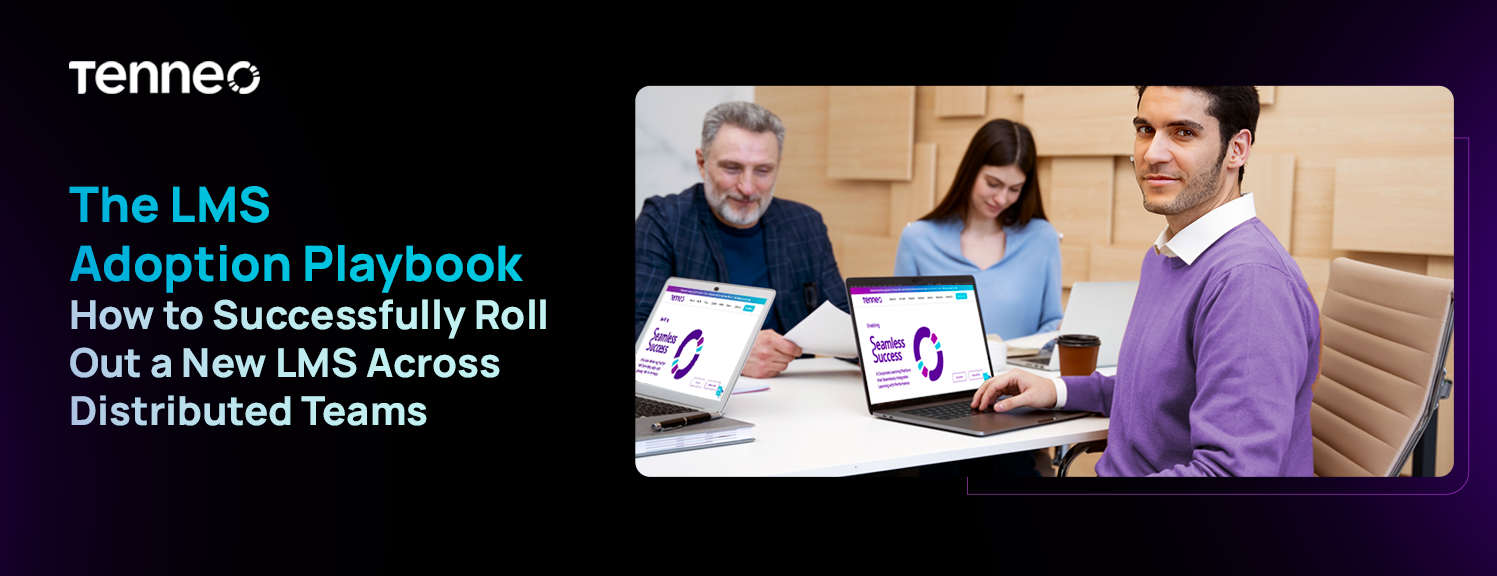
Rolling out a new LMS is never just a technology upgrade; it’s a change initiative that directly impacts how people learn, perform, and grow across your whole organization.
And when your teams are distributed across regions, the complexity increases. Different time zones. Different learning cultures. Different levels of digital maturity. Yet organizations that get LMS adoption right witness learning that becomes consistent, measurable, and deeply connected to their business outcomes.
This playbook walks you through how to successfully adopt a new LMS software across distributed teams, with practical insights drawn from real-world enterprise rollouts, specifically using a modern corporate LMS like Tenneo LMS.
Why LMS Adoption Fails (Before We Fix It)
Before diving into solutions, let’s address a hard truth: Most LMS implementations don’t fail because of poor features. They fail because people don’t use them.
Common reasons include:
- The LMS feels forced rather than helpful
- Training doesn’t align with real job roles
- Managers don’t reinforce learning
- Global teams feel the LMS was designed for HQ, rather than for them
Step 1: Define the “Why” Before the “What”
Before launching your LMS software, get clear on one question: What business problems is this LMS solving? For example, across regions like UAE, Singapore, and the Philippines, organizations often adopt an LMS to:
- Standardize training across locations
- Reduce dependency on classroom training
- Improve compliance and audit readiness
- Enable faster onboarding for growing teams
- Build future-ready skills at scale
Meaning, when teams understand why their LMS exists, adoption becomes purposeful. And with Tenneo LMS, organizations align learning goals directly with performance metrics, helping learners see how training impacts their roles along with their completion status.
Step 2: Design for Distributed Teams
A common mistake in LMS adoption is designing learning centrally and assuming it works everywhere. However, distributed teams need:
- Flexible access across devices
- Self-paced learning for differing time zones
- Contextual localized content relevant to regional roles
- Simple navigation for varied digital comfort levels
Tenneo LMS is built to support this regional customization within a unified system, ensuring consistency without rigidity.
Step 3: Involve Managers Early (They Drive Adoption)
Here’s a truth many LMS projects overlook: Employees don’t adopt LMS platforms. Managers do.
Managers influence:
- Whether learning time is prioritized
- Whether courses feel relevant
- Whether learning translates into performance
Therefore, make managers your LMS champions by:
- Giving them dashboards to track team progress
- Aligning LMS goals with team KPIs
- Enabling managers to assign learning tied to real work
With Tenneo LMS, managers gain visibility into skill gaps and learning progress, turning your LMS into a performance tool.
Step 4: Launch in Phases, Not All at Once
A successful LMS rollout across distributed teams is incremental and thus avoids overwhelming your teams with these phases:
- Phase 1: Pilot launch to gather feedback from users in different geographies
- Phase 2: Optimize & localize with course relevance, language or cultural context & learner experience
- Phase 3: Organization-wide rollout once the LMS is tested, trusted & refined
Step 5: Make Learning Feel Seamless
If your LMS feels like another compliance tool, adoption will drop fast. High-performing organizations:
- Use conversational content
- Incorporate real-world scenarios
- Encourage peer learning & discussion
- Celebrate milestones & achievements
This especially matters to distributed teams whose learning can feel isolating. A learner-centric corporate LMS like Tenneo thus focuses on:
- Personalized learning journeys
- Skill-based recommendations
- Simple, intuitive interfaces
Step 6: Communicate Like a Product Launch
Your LMS deserves more than a single announcement email. Treat it like an internal product launch; share what’s new and why it matters, highlight “What’s in it for me?” for learners, use short videos, demos, and manager nudges, and reinforce messaging over time.
Across geographies, this consistent communication ensures no team feels left out of the learning ecosystem.
Step 7: Measure What Matters (And Act on It)
Adoption doesn’t stop at login rates. Thus, track for:
- Skill progression
- Course completion quality
- Manager engagement
- Performance improvement
The real success of an LMS lies in how it improves capability and outcomes.
Final Thoughts: LMS Adoption Is a Journey, Not an Event
Rolling out a new LMS software across distributed teams in UAE, Singapore, and the Philippines is about building:
- A shared learning culture
- Consistent capability across regions
- A future-ready workforce
When approached strategically, a corporate LMS like Tenneo LMS becomes the backbone of your organizational growth. The key is simple: Design for people first. Then technology will follow. If you’re navigating decisions around LMS adoption, it’s okay if everything isn’t clear yet.
For many organizations, exploring how modern platforms such as Tenneo LMS approach learning through flexibility, scalability, and learner-centric design can help bring that clarity without pressure or urgency. Connect with our experts today to get your tailored handbook.