

April 7, 2026

Are We Confusing Engagement with Noise in Learning Platforms?
February 12, 2026
AI-Native vs AI-Added LMS: Why the Future of LMS Is AI-Native, Not AI-Added
January 19, 2026Are We Confusing Engagement with Noise in Learning Platforms?
February 12, 2026AI-Native vs AI-Added LMS: Why the Future of LMS Is AI-Native, Not AI-Added
January 19, 2026Building Future-Ready Tech Architectures: Balancing Innovation and Scalability
Technology architecture has quietly become one of the most strategic levers in modern organizations. What was once viewed as an engineering concern is now a decisive factor in business agility, learning effectiveness, and long-term competitiveness. In a world shaped by AI, cloud platforms, digital learning ecosystems, and rapidly evolving customer expectations, architecture determines whether organizations merely adopt change-or lead it.
The challenge is clear: how do we embrace innovation without compromising scalability, resilience, and trust? The answer lies in building future-ready architectures-systems intentionally designed to evolve.
From Systems of Record to Systems of Evolution
Traditional enterprise platforms were built as systems of record: stable, centralized, and slow to change. Today, organizations need systems of evolution-architectures that can continuously absorb new capabilities without disruption.
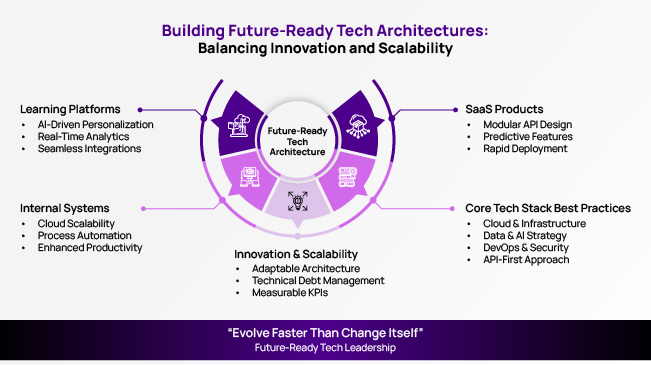
This shift is especially visible in Learning Management Systems (LMS). Earlier LMS platforms focused on content storage and compliance tracking. Modern learning ecosystems must support AI-driven personalization, real-time analytics, mobile access, and seamless integration with HR, content partners, and enterprise tools. Organizations that succeed here design stable core services while allowing innovation to flourish at the edges-recommendation engines, analytics layers, and AI tutors evolve independently without destabilizing the platform.
Stability, in future-ready systems, is not rigidity. It is controlled adaptability.
Innovation with Architectural Intent
Emerging technologies promise speed and differentiation, but innovation without architectural intent creates fragmentation and technical debt. Visionary organizations adopt innovation through discipline-not hesitation.
In SaaS product platforms, this discipline is often visible through modular, API-first architectures. AI features such as predictive insights or workflow automation are introduced as independent services rather than tightly coupled dependencies. This allows teams to iterate, scale, or even replace technologies as they mature-without rewriting core systems.
The lesson is simple: future-ready architectures treat emerging technologies as capabilities, not commitments.
Scalability Is a Business KPI
Scalability is often misunderstood as a technical problem. In reality, it is a business enabler. Platforms that scale smoothly protect customer experience, reduce operational risk, and enable faster go-to-market.
Consider internal enterprise platforms—HR systems, finance tools, or engineering productivity platforms. These systems often begin with limited scope but rapidly expand in users and use cases. Organizations that invest early in cloud-native principles—horizontal scaling, stateless services, automation, and observability-are able to support 3–5× growth without proportional increases in cost or operational complexity.
When scalability increases friction, architecture has already failed.
Measuring Architecture Maturity: KPIs That Matter
Vision without measurement remains aspiration. Future-ready organizations track architectural success through metrics aligned to business outcomes.
LMS & Learning Platforms
- Concurrent user scalability during peak learning cycles
- Time to launch new courses or learning modules
- Adoption rate of personalized or AI-driven learning paths
- Learning data latency for analytics and insights
Organizations with modular LMS architectures often reduce content deployment time by 40–60% while enabling continuous innovation.
SaaS Platforms
- Release frequency and change failure rate
- Mean Time to Recovery (MTTR)
- Cost-to-scale ratio as users or transactions grow
Mature SaaS platforms frequently achieve 2–3× faster feature delivery without sacrificing reliability.
Internal Platforms
- User adoption and self-service ratios
- Automation coverage of critical workflows
- Performance consistency during peak usage
Such platforms routinely unlock 20–30% productivity gains across teams.
Technical Debt Is a Leadership Decision
Every platform accumulates technical debt. What differentiates future-ready organizations is how deliberately that debt is managed. Regular modernization, refactoring, and platform reviews are embedded into strategic roadmaps-not deferred indefinitely.
For CXOs, architectural health is a business asset. Systems that are scalable, observable, and well-governed reduce risk, accelerate innovation, and lower long-term costs.
Culture: The Invisible Architecture
No architecture succeeds without the right culture. Empowered teams, clear ownership, and continuous upskilling in cloud, AI, security, and system design ensure that platforms evolve alongside people. Architecture ultimately reflects how organizations think, collaborate, and learn.
At Tenneo, we don’t jut advocate best practices-we live them.
The same architectural principles we recommend to our customers are applied rigorously in building and evolving our own platforms. By embedding scalability, resilience, and adaptability into our core technology stack, we ensure that our products are not only ready for today’s demands but engineered to grow with the future.
At Tenneo, best practices are not guidelines-they are our operating standard.
“Future-ready architecture isn’t about choosing the latest technology.
It’s about creating systems that can evolve faster than change itself.
When innovation and scalability move together, technology becomes a true competitive advantage.”
— Ashok Singh