

Learning Management System vs Learning Experience Platform: A Simple Guide
March 17, 2026
Microlearning vs Traditional Training: What Works at Scale in LMS Platforms?
April 1, 2026
If your learning platform isn’t getting the engagement you expected, you are not alone.
Most organizations today already have strong content and capable LMS platforms in place. Yet adoption often remains limited; employees log in when required, complete assigned courses, and move on. It’s an experience issue.
Because learning is not just about access. It’s about how easily people can understand, process, and apply what they see. AI has started to make a meaningful difference by making learning easier to navigate, absorb, and use in real work.
Why adoption drops, even with good systems
In many cases, a corporate learning platform is built with the right intent but still creates friction for employees.
When someone logs in and sees too many options or learning content that doesn’t clearly relate to their role, it slows them down. If the platform takes effort to navigate or feels disconnected from their day-to-day work, learning quickly becomes something they postpone.
Even well-established corporate learning management systems can struggle here, especially when learning is structured as long, static modules that demand time and focus employees don’t always have. Over time, employees start avoiding the platform altogether.
Where AI changes the experience
AI introduces a subtle but important shift in how LMS platforms function. Instead of expecting employees to figure out what to do, the platform starts guiding them. Instead of offering the same experience to everyone, it adapts to individual needs.
This reduces cognitive load and makes it easier for employees to stay focused. When learning feels clear and easy to absorb, adoption improves naturally.
- Creating clarity from the first interaction
One of the biggest cognitive barriers is not knowing where to begin. AI helps shape a guided experience within the corporate learning platform, recommending what to focus on next and removing unnecessary choices. This reduces decision fatigue and allows employees to start learning without hesitation.
Clarity at the start leads to higher continuation.
- Making learning easier to process
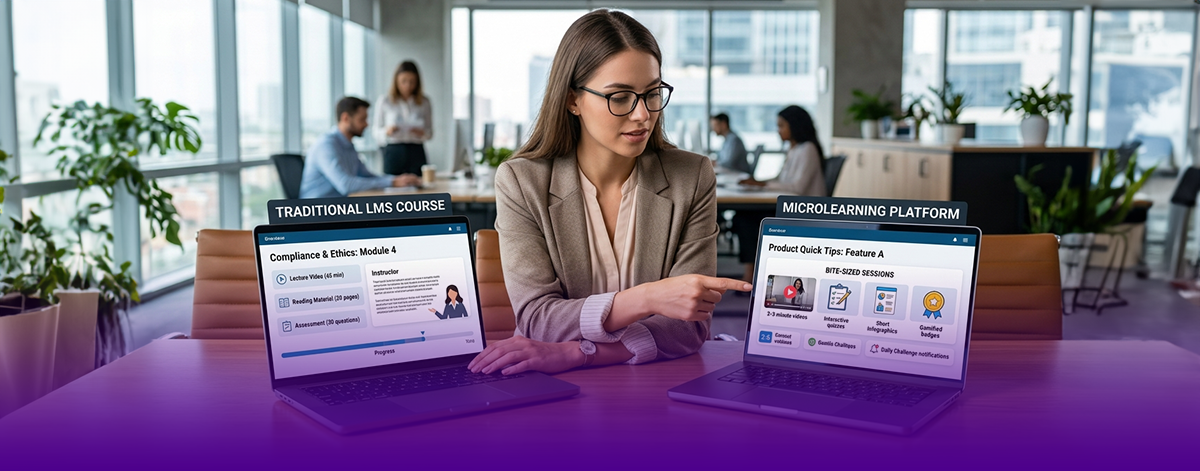
Lengthy, dense content often leads to low retention. AI helps corporate learning management systems present learning in smaller, structured formats that are easier to understand. It can break down complex topics, recommend bite-sized content, and surface information in a way that aligns with how people naturally consume information.
This improves comprehension and makes learning feel less overwhelming.
- Keeping learning relevant to reduce mental effort
When content is not relevant, employees spend more effort trying to understand why it matters.
AI removes this friction by tailoring learning to individual roles and needs. Within a corporate learning platform, this means employees see learning that directly connects to their work, reducing the mental effort required to engage with it.
Relevance simplifies thinking, and that keeps attention intact.
- Bringing learning into the flow of work
Cognition also depends on context. Employees understand and retain information better when they can apply it immediately. AI-enabled LMS platforms support this by surfacing learning in real-time, during actual tasks.
This reduces the gap between learning and doing, making it easier for employees to connect concepts with action.
Learning becomes more practical and easier to remember.
- Supporting recall and reinforcement
Learning doesn’t stick without reinforcement. AI helps corporate learning management systems revisit key concepts through timely nudges, follow-ups, and reminders. This strengthens memory and improves retention without requiring additional effort from the employee.
Instead of forgetting what they learned, employees build on it over time.
- Simplifying the experience to reduce overload
Cognitive load increases when systems feel complex.
AI helps simplify LMS platforms by organizing content intelligently and highlighting what matters most. This creates a more intuitive experience where employees don’t feel overwhelmed by options or navigation.
When the platform feels light and easy, employees stay longer and engage more.
- Making progress visible and meaningful
People stay engaged when they can see progress and understand their growth.
AI enables corporate learning management systems to show learning progression in a clear and structured way. This helps employees process their journey, reinforcing a sense of achievement and direction.
When learning feels meaningful, it becomes easier to continue.
Rethinking the role of your LMS
AI is not just improving features; it’s reshaping how LMS platforms support both experience and cognition. It moves learning from:
- Complex → Clear
- Overwhelming → Manageable
- Generic → Relevant
- One-time → Reinforced
This is what a modern corporate learning platform must deliver to improve adoption.
Final thought
If adoption is low, the issue may not be access; it may be how learning is experienced and understood. Is your LMS platform easy to navigate, process, and apply, or does it require effort at every step?
AI helps reduce that effort. And when learning feels simple, clear, and useful, employees don’t just log in because they must. They return because it works for them.
But every organization’s reality is different. What has your experience been with your current LMS platforms? Are your employees engaging with ease or trying to figure things out?
Would be great to hear your perspective here.
Other Articles