

Unified Learning Is Having Its Moment—And Enterprises Are Catching Up
April 15, 2026
How AI Improves Learning Adoption Rates in LMS Platforms
March 20, 2026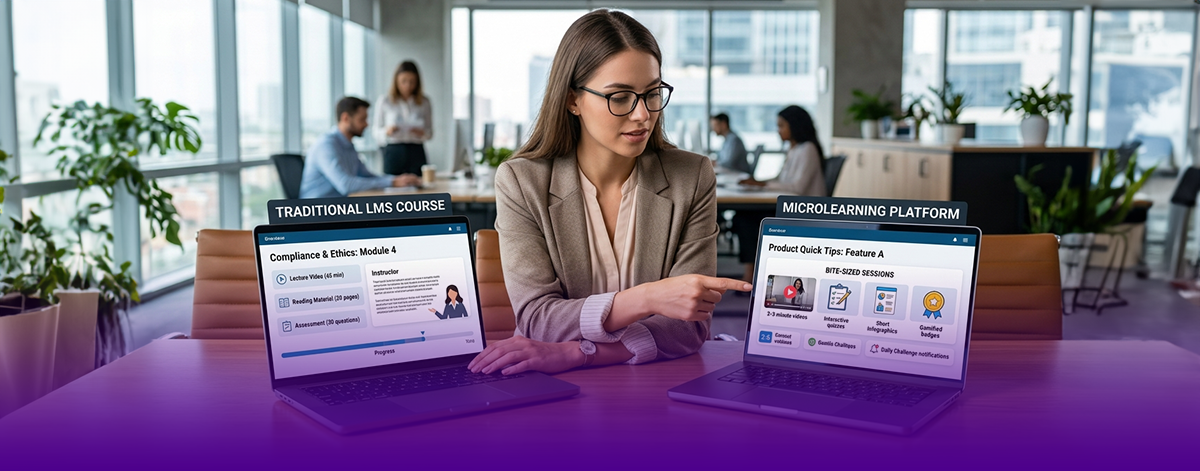
Table of contents
Making learning bigger is not the real goal. Making it work well is. Today, many organizations find it hard to help people remember what they learn, use it in real work, and make it useful for different teams that are always busy and changing.
Structured programs, detailed modules, and scheduled sessions in the best learning management platforms (LMS) have helped build deep capability.
But they were designed for a different pace of work, one where employees could step away, focus, and return later to apply what they learned. That reality has changed. Today, learning is happening in between meetings, during tasks, and often under pressure. Employees are adapting constantly, but not always with the support they need from LMS platforms.
Microlearning consists of short, focused learning modules that fit seamlessly into the workday, just like any other task. It makes learning easier to access and quicker to apply in real work situations.
So instead of asking which approach for LMS platforms is better, a more useful question is: what works when you’re trying to scale learning across the organization?
The Learner Lens: How People Actually Learn Today
The biggest shift is in behavior. Employees no longer have the luxury of uninterrupted time for long training sessions. Their workdays are fragmented, and attention is limited. Traditional training, which often requires dedicated time and focus, becomes harder to sustain at scale.
Microlearning in LMS platforms responds to this shift by making learning lighter and more accessible. The platform supports content broken into smaller pieces that can be consumed quickly and applied immediately.
At scale, this matters. Because learning that fits into work is far more likely to be used than learning that competes with it.
The Engagement Lens: Completion vs Continuity
In many organizations, training success is still measured by completion rates. But completion doesn’t guarantee engagement or impact. Traditional programs often see strong initial participation but struggle to maintain momentum. They feel like events, something to finish and move on from.
Microlearning creates a different pattern. It encourages repeated interaction. It builds learning into everyday routines, making it easier for employees to come back, revisit, and reinforce.
At scale, engagement is a habit. And learning that becomes a habit is far more powerful than learning that is completed once.
The Retention Lens: What Actually Sticks
Retention improves when learning is spaced and relevant. One of the biggest risks with long-form training is overload. Even well-designed programs can deliver too much information at once, making it difficult for learners to retain and apply what they’ve learned.
Microlearning improves this by spacing content over time and focusing on one idea at a time. It aligns better with how memory works, through repetition and reinforcement.
But depth still matters. Some skills require structured, immersive learning that goes beyond quick interventions. At scale, retention works best when depth and reinforcement come together.
The Business Lens: Speed and Agility
Organizations today are constantly evolving. New tools, new processes, and new expectations require employees to learn quickly and continuously.
Traditional training models can struggle here. They take time to design, deploy, and update. Microlearning offers agility. It allows organizations to respond faster, deliver learning in real time, and support employees at the moment of need. At scale, learning must move at the speed of the business.
The Measurement Lens: From Activity to Impact
Measurement must move beyond activity. Tracking attendance or completion provides limited insight into whether learning is making a difference. At scale, this becomes even more critical because small inefficiencies multiply quickly.
Modern learning platforms now enable deeper visibility. They connect learning with skill development, behavior change, and performance outcomes. Microlearning, especially when paired with modern LMS platforms:
- Tracks engagement patterns
- Links learning to on-the-job actions
- Enables continuous feedback loops
Microlearning, supported by AI, becomes powerful. It allows learning to adapt, recommending what’s relevant, guiding next steps, and adjusting based on behavior.
A Simple Framework
At scale, the winning approach looks like this:
- Start with structured learning (for core knowledge)
- Follow with microlearning (for reinforcement)
- Embed learning into work (for application)
- Use AI to personalize and guide (for relevance)
A Quick Thought to Leave You With
At scale, personalization drives engagement. Scaling learning is about delivering better. Microlearning makes learning easier to access and apply.
Traditional training makes it deeper and more meaningful. But impact comes from how well they work together. Because in the end, the goal is to help your workforce navigate, learn, grow, and perform consistently, and at scale.
Other Articles