

eLearning Authoring Tool: Complete Guide
October 1, 2026
Tenneo vs Docebo: 2026 Enterprise LMS Comparison
June 30, 2026
Table of contents
- Why is an LMS Important for Any Business?
- Your Five Step-by-Step Guide to Choosing an Enterprise LMS
- Step 2: Look for LMS Essential Features
- Step 3: Digital Learning Content Solutions
- Step 4: Evaluate the Enterprise LMS Vendor
- Step 5: Compare Pricing, ROI, and Final Decision
- Why Tenneo Is the Right Enterprise LMS for Growing Businesses
- See How Tenneo Solves Enterprise Learning Challenges
- FAQ
Why is an LMS Important for Any Business?
An LMS is a platform that helps businesses create, manage, deliver, and track employee training programs in single platform. Whether an organization has 10 or 10,000 employees, an LMS can centralize training activities and provide greater visibility into learner progress, completion, and performance.
A growing company may need new-hire onboarding, safety training, policy acknowledgments, sales enablement, leadership development, and software training at the same time. A corporate LMS keeps those programs organized and gives managers visibility into progress.
A well-planned LMS can support:
- New-hire onboarding
- Compliance and policy training
- Leadership development
- Product and process training
- Sales and service training
- Employee upskilling and reskilling
- Certification management
- Partner and customer education
Your Five Step-by-Step Guide to Choosing an Enterprise LMS
Step 1: Brainstorming: Define Your Learning Strategy and Business Requirements
The first stage of selecting an enterprise LMS is to step back from the technology and focus on your goals.
You need to understand your internal needs before searching for an LMS.
First - Identify Your Learners: A clear learner map is the first step in finding the right LMS.
- Internal employees
- New hires and onboarding teams
- Leadership and management teams
- Sales and customer support teams
- Frontline, field, and deskless workers
- Technical or operational teams
- Contractors, partners, and customers
- Employees working toward certifications
Second - Define Business Objectives
Business objectives give the LMS project direction. Broad goals such as “improve learning” are hard to measure and defend during budget discussions.
Most Enterprise companies invest in an LMS to improve one or more of the following areas:
- Compliance completion and audit readiness
- Employee onboarding
- Time to productivity
- Upskilling and reskilling
- Leadership development
- Product knowledge
- Sales readiness
- Employee retention
- Internal mobility
- Training reporting
Third - Budgeting
Budgeting plays an important role when selecting an LMS because the total cost goes beyond the software subscription.
Budget items often include:
- Annual LMS license fee
- Implementation and configuration
- User and course migration
- HRIS, single sign-on, and payroll integrations
- Content library access
- Custom eLearning development
- Administrator training
- Premium support
- Internal project time
Fourth - Organizational Complexity:
A company with 500 employees may still need enterprise-level controls if it operates across locations, manages regulated training, supports different roles, or serves external learners.
Key factors include:
- Current employee count and hiring plans
- Department-wise training needs
- Multiple locations or business units
- Multi-language training
- Remote, hybrid, and frontline teams
- Required compliance programs
- External learners, such as partners and customers
- Existing HR, payroll, CRM, or collaboration tools
Also Read: Compare 10 LMS Platforms for Enterprise (Features and Pricing) 2026
Step 2: Look for LMS Essential Features
Scalability
An LMS platform's ability to handle:
- Large Course
- Bulk user management
- AI-driven Training
- Automated user provisioning
- Role-based admin access
- Multi-language and Location support
- Mobile access
AI-Based Capabilities
AI can suggest personalized courses based on user activity and automatically translate training materials into different languages. It also helps managers quickly create quizzes and tests.
Learning Experience
Employees are more likely to complete training when assigned courses, due dates, recommendations, and search tools are easy to find.
A useful learner dashboard includes:
- Assigned learning
- Course progress
- Due dates
- Certificates
- Search
- Personalized recommendations
- Mobile access
- Learning history
- Easy access to job aids and resources
Security and Compliance
Data privacy is absolutely critical for any large enterprise organization. A secure cloud-based LMS must offer robust data encryption standards. Ensure the platform complies with GDPR, SOC 2, and ISO certifications. Single Sign-On (SSO) is required to prevent unauthorized system access.
Customer Support
Choose an LMS that provides quick and reliable support. Look for 24/7 helpdesk service and dedicated support managers. Fast help keeps your training programs running smoothly.
Step 3: Digital Learning Content Solutions
Static PDFs and monotonous slide decks fail to capture attention. Today’s learners prefer interactive, short, and visually appealing training content.
Here is how leading solutions like Tenneo enhance your content strategy:
Gamification: Turn boring training into exciting competitive challenges. Use leaderboards, digital badges, and points to motivate your employees.
Microlearning: Break complex topics into short, three-minute training bursts. This perfectly matches the short attention spans of modern workers.
Interactive Video Training: Embed pop-up quizzes directly inside your training videos. This forces learners to actively engage instead of passively watching.
AI Content Creation: Quickly turn regular text into interesting course modules. AI can create related images, voice recordings, and clear summaries.
Off-the-Shelf Libraries: Instantly access thousands of pre-built professional courses. Cover topics like workplace harassment, software skills, and leadership.
Immersive Simulations: Create virtual environments for risk-free employee practice. This is highly effective for complex software or machinery training.
Step 4: Evaluate the Enterprise LMS Vendor
Once you know the features and capabilities your organization needs, the next step is to evaluate the LMS vendors.
1. Check Customer Reviews and references on software evaluation platforms like G2 Learning Management Systems, Gartner, and Capterra.
2. Read Case studies and client testimonials.
3. Before making a final decision, request a demo of shortlisted LMS vendors. Use the demo to see how the platform works in real-world scenarios and whether it fits your organization's learning requirements.
The review team should include HR, L&D, IT, compliance, managers, and a few employees. Each group will notice different issues, especially around reporting, integrations, security, and usability.
LMS Evaluation Checklist:
- User Experience
- Scalability
- Automation
- Content Management
- Mobile Learning
- Integrations
- Reports & Analytics
- Customer Support
- Pricing
- Product Demo
Step 5: Compare Pricing, ROI, and Final Decision
Software pricing plans can be confusing. Ask vendors for complete transparency about costs. Once you understand the total cost, compare it with the expected value and ROI to make a final decision.
Understand the Pricing Model: Per-User Pricing, Active-User Pricing, Custom Pricing
Hidden Costs: Implementation Fees, Customization Charges, Integration Charges, Support, Content Migration
Why Tenneo Is the Right Enterprise LMS for Growing Businesses
- Tenneo is a strong choice for fast-growing businesses. With over 30 years of experience, it has supported more than 300 large enterprise implementations worldwide. More than 4.5 million users depend on their platform every day.
- It has proven expertise across highly regulated and complex industries. They excel in BFSI, Pharma, Healthcare, Automotive, Retail, and IT. Their platform easily adapts to the unique compliance demands of these sectors.
Proven customer success stories:
- Axis Bank: Tenneo quickly deployed a massive workforce training project. Axis Bank highly praised their quick turnaround time and support.
- SBI Card: Tenneo successfully engaged over 28,000 workers daily. They drastically reduced employee induction training from 31 to 22 days.
- Lufthansa Technik Philippines: Highly complex aviation training demands robust, reliable infrastructure. Tenneo provides the flawless digital learning environment that global leaders require.
Here is the Comparison Table Tenneo LMS Vs Other LMS
| Capability | Tenneo LMS | Other Enterprise LMS Platforms |
|---|---|---|
| Generative AI Assistant | AI Tenneo Assistant for admins and learners; English only | Basic AI assistants or limited use cases |
| AI Assessment Creation | Up to 15 questions, difficulty mapping, 20MB uploads; Beta | Basic AI question generation |
| AI Proctoring | Face detection, screen monitoring, gaze tracking; live and automated; Add-on | Basic or limited proctoring capabilities |
| AI Video Coaching | Sales and service simulations with feedback on tone and delivery; Add-on | Limited video assessment or coaching |
| AI Multilingual | 50+ languages for PDF, PPT, and DOCX; Add-on | Limited language support |
| Compliance Rule Sets | Masters with certifications and artifact submission | Basic compliance course tracking |
| Compliance Expiry | Validity periods with reauthorization | Basic expiry reminders |
| Compliance Prerequisites | Vintage, department, and dynamic attributes | Basic prerequisite rules |
| Digital Signature | Built-in for completions and announcements | Limited or third-party integrations |
| Statutory Audit Logs | Built for statutory audits | Basic activity or audit logs |
| Learning-to-Performance | LPP with external KPIs via CSV and SFTP; unlimited rules | Limited performance tracking |
| On-the-Job Evaluation | Checklists, 360 feedback, approval workflows, and mobile | Basic evaluations or feedback |
| Spaced Reinforcement | SMS, email, and app delivery | Email or app-based reminders |
| Mobile Offline | Offline SCORM with sync and QR attendance | Limited offline capabilities |
| Security Certifications | N/A | Platform-dependent |
| Integrations | 100+ connectors including Zoom, Teams, Webex, Google, and Canva | Standard integrations |
| Implementation | From 8 weeks, including planning to hypercare | Standard implementation support |
| Plan Structure | 4 variants: Learn, Learn+, Grow, Act | Typically tiered plans or packages |
See How Tenneo Solves Enterprise Learning Challenges
1. Role-Based Learning Paths
Each employee has unique responsibilities and skill needs.
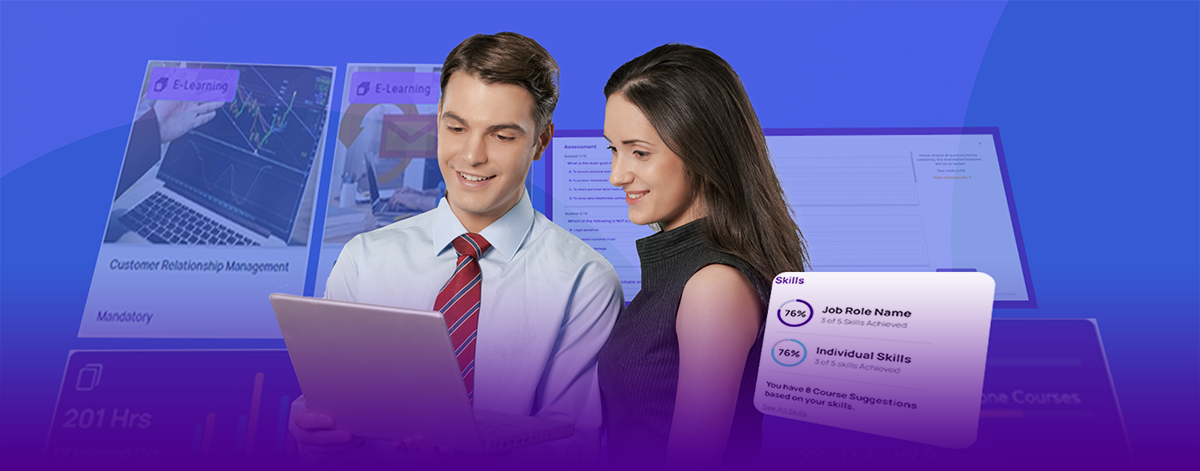
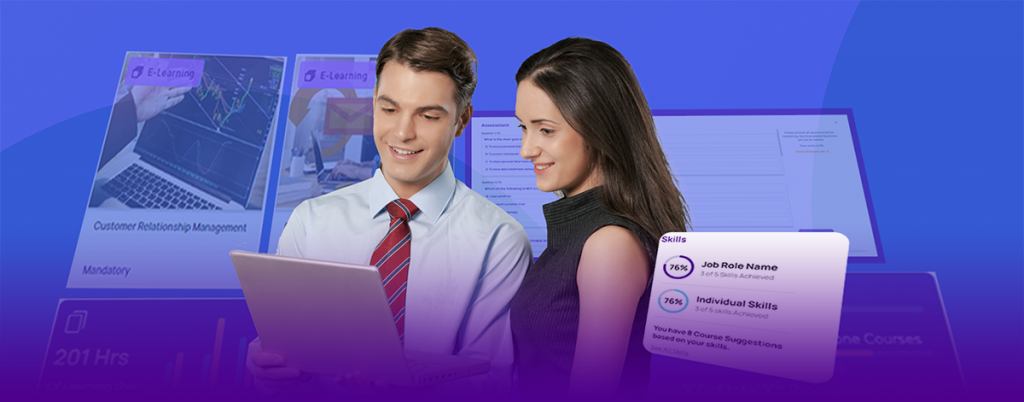
Tenneo helps organizations assign the right training by job role, department, competency, and development needs. The Skill Path capability shows job-role competencies, learner progress, achievement dates, and learning sources.
Employees can also see which skills their roles require. Managers can identify skill gaps and support targeted development plans.
2. AI-Powered Adaptive Learning
Tenneo uses AI features for personalized learning, smart search, adaptive support, content transformation, and skill-gap insights.
The platform also supports AI-assisted localization. This feature can help organizations deliver training in multiple languages without building separate programs from scratch.
3. Track Employee Progress and Learning Analytics
Tenneo provides learner analytics through dashboard widgets. Employees can view learning hours, course completion status, learning metrics, compliance levels, skill gaps, and individual development plans.
Custom reports and dashboards give HR, L&D teams, and managers a clearer view of training activity. Reporting can support more informed decisions around compliance, skills, learning participation, and program performance.
4. Mobile Learning App
Tenneo’s mobile app gives learners access to courses, assignments, resources, progress tracking, and interactive content on the go. That access is useful for frontline teams, remote employees, sales teams, and employees without regular desktop access.
5. Digital Learning Content (eLearning)
Tenneo supports eLearning courses, videos, documents, interactive content, deep links, content channels, and course calendars. Learners can access assigned courses, public offerings, and role-based suggestions through the platform.
Content can also connect with external libraries and authoring tools. Tenneo includes a Canva integration for direct access to Canva-created learning content inside the LMS.
6. Compliance Management
Compliance management is especially useful for organizations in financial services, healthcare, manufacturing, and other regulated sector. Clear reports help HR and compliance teams prepare for audits without relying on manual spreadsheets.
Tenneo’s Compliance Engine goes beyond delivering compliance courses. It helps organizations manage compliance learning as an ongoing workforce and business requirement. Tenneo combines learning, AI, automation, and workforce intelligence to help organizations:
- Automatically assign compliance training based on roles and requirements.
- Manage mandatory and recurring training.
- Automate reminders and follow-ups.
- Track course completion, assessments, certifications, and compliance status.
- Identify learning and compliance gaps.
- Generate actionable compliance insights and reports.
- Maintain learning records for greater visibility and audit readiness.
7. Content Library
Tenneo provides large, ready-made content libraries, so you can quickly launch courses on subjects like cybersecurity, leadership, and workplace safety without building them from scratch.
A central learning space can give employees one place to find role-specific resources, compliance materials, skill development content, and self-directed learning options.
FAQ
What features should an Enterprise LMS have?
An enterprise LMS should include user management, role-based learning paths, automated assignments, reporting, assessments, certifications, mobile access, integrations, security controls, compliance tracking, and customer support. The exact feature mix should match the company’s learner groups, industry, growth plans, and training goals.
Why is AI important in an Enterprise LMS?
AI can help employees find relevant training faster and help L&D teams reduce repetitive tasks. Common AI uses include personalized recommendations, skills-based learning paths, smart search, content creation support, learning analytics, translation, and skill-gap identification.
What is the difference between a standard LMS and an Enterprise LMS?
A standard LMS may focus on course delivery and basic completion tracking. An enterprise LMS supports more complex requirements, including multiple departments, large learner groups, compliance programs, integrations, role-based access, advanced reporting, automation, and multi-language learning.
What security features should an Enterprise LMS include?
An enterprise LMS should include single sign-on support, role-based permissions, data encryption, audit logs, data backup, privacy controls, data retention policies, and secure integrations. IT and security teams should review the vendor’s security documentation before contract approval.
Other Articles