

Unified Learning Is Having Its Moment—And Enterprises Are Catching Up
April 15, 2026
For years, organizations invested in corporate learning management systems with a clear objective to scale training, standardize knowledge, and ensure compliance. And for a time, that worked.
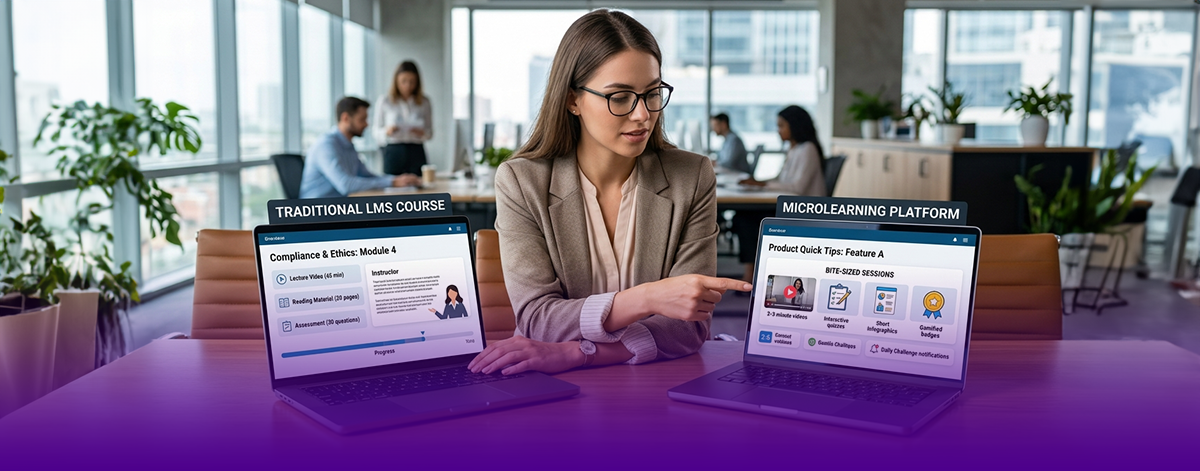
But as businesses grew more dynamic, a gap began to surface. Learning was happening, yet performance wasn’t always improving at the same pace. Employees completed courses but struggled to apply knowledge in real-world scenarios. The challenge was the lack of relevance, context, and continuity. This is where the shift toward experience-first learning begins.
What Is Experience-First Learning?
Experience-first learning redefines how organizations think about capability building. Instead of focusing on what content needs to be delivered, it focuses on how learning is experienced by the individual and whether that experience actually enables better performance.
It acknowledges that learning is a continuous, evolving interaction shaped by role, behavior, and context.
Why Personalization Is Becoming the New Standard
The modern workforce expects the same level of relevance and ease from learning as they do from the tools they use every day. When learning aligns with individual roles, current challenges, and career aspirations, it becomes meaningful.
This means modern Learning Management Systems (LMS) must evolve into systems that interpret learner behavior, anticipate needs, and guide individuals through journeys that feel intuitive rather than assigned.
However, personalization in learning is often misunderstood. Many organizations equate it with surface-level customization, such as adjusting dashboards, assigning different courses, or segmenting users. True personalization goes deeper.
It is dynamic, continuously shaped by data, and responsive to how individuals engage, perform, and progress over time. It reflects what learners need in that exact moment to move forward. This is where the nuance of experience-first learning becomes important.
Key Nuances of Experience-First Learning
A well-designed learning experience does not overwhelm the learner with choices, nor does it rigidly control their path. It strikes a balance between guidance and autonomy.
Employees should feel supported and empowered with a learning platform by their side. Achieving this balance requires a strong foundation of data, behavioral signals, skill insights, and performance metrics that together create a meaningful picture of the learner. Without this, even the best LMS software struggles to deliver anything beyond generic recommendations.
Another important layer is how learning fits into the flow of work. Employees today do not have the time or inclination to step away from their responsibilities for disconnected training experiences.
Learning must appear when it is needed most, which is during decision-making, problem-solving, or execution. This contextual delivery transforms learning from a separate activity into a seamless extension of work itself. At the same time, decision-makers must approach this shift with clarity and caution.
Where Decision Makers Need to Be Careful
One of the most common missteps is being drawn to feature-heavy LMS platforms that promise personalization but deliver only static or rule-based experiences.
- Technology alone cannot create meaningful learning journeys. It must be backed by a clear strategy that connects learning to business outcomes. Without this alignment, personalization risks becoming fragmented, engaging in the short term but inconsistent in building long-term capability.
- There is also a tendency to over-personalize. While tailoring learning to individuals is valuable, organizations must ensure that core competencies remain consistent across teams. Too much divergence can lead to uneven skill development, making it difficult to maintain organizational standards. The goal is to create adaptable pathways within a structured framework.
- Content quality remains another critical factor that is often underestimated. Even the most advanced systems cannot compensate for content that lacks context or practical relevance. Experience-first learning demands content that reflects real scenarios, encourages decision-making, and supports application. Without this, personalization loses its impact.
- Equally important is the ethical use of data. Personalization relies on collecting and interpreting learner data, which makes transparency and trust essential. Organizations must be deliberate about how data is used, ensuring it enhances the learner experience without crossing boundaries. A lack of clarity here can quickly erode confidence in the system.
- When evaluating corporate learning management systems, decision-makers need to shift their lens from features to outcomes. The right platform should demonstrate an ability to evolve with the learner, integrate seamlessly with business systems, and provide insights that go beyond completion metrics. It should enable organizations to understand what employees are learning, but how that learning is influencing performance. Equally, the experience must feel intuitive. If the platform requires effort to navigate or feels disconnected from daily work, adoption will remain a challenge regardless of its capabilities.
Today, learners are influenced by consumer-grade digital experiences, and expectations are naturally higher.
Ultimately, experience-first learning isn’t about adding more; it’s about making things easier. It’s about creating a space where learning fits naturally into work, feels relevant, and actually helps people do their jobs better.
The organizations that will move ahead aren’t just the ones adopting new LMS platforms, but the ones that start looking at learning differently, as something that directly shapes performance every day.
So maybe the real question to pause on is: How are you looking at learning today?
Are you measuring it by completion, or by how confident and capable your people feel when it actually matters?
Because in the end, that’s what truly defines experience-first learning.
Other Articles