
What a SCORM-Compliant LMS Mean for Your Business
December 18, 2025
LMS for Compliance Training – Benefits and Best Practices
December 26, 2025
Customers today expect quick and consistent human interactions across channels. These moments are crucial for business success and depend on customer service teams making real-time decisions.
This customer service performance is shaped by how well the service agents are supported by their organizations and how continuously they learn, making the role of an LMS in customer services central to scaling and sustaining satisfactory customer experiences.
This is where the role of LMS in customer services is becoming central to how organizations train, scale, and strengthen their customer service.
Why Customer Service Training Must Evolve
Customer service isn’t a one-time learned skill. Rather, customer service evolves with changing customer behavior, product updates, regulations, and new communication channels. Yet many organizations still depend on outdated training, long onboarding programs, static modules, and infrequent refreshers that rarely reflect real customer situations.
The negative impact of this outdated training shows up quickly. New hires struggle to apply what they’ve learned while experienced agents revert to habits that no longer align with brand expectations. Over time, service quality becomes inconsistent.
Yet a modern learning management system makes a meaningful improvement by ensuring that employee learning remains continuous, contextual, and closely tied to real customer interactions.
LMS as the Backbone of Modern Customer Service Learning
At a basic level, an LMS centralizes training content and tracks learning progress. And when designed for LMS customer services, its impact is far more impactful.
In this case an LMS becomes the place where service standards live, updates are communicated instantly, and teams return whenever they need clarity. Instead of treating training as an event, the LMS turns learning into an ongoing support system that’s available before, during, and after customer interactions.
This shift significantly improves confidence and consistency across customer-facing teams. And platforms like Tenneo’s Customer Service Training LMS are designed specifically for the evolving needs of customer service teams.
Backed by over two decades of experience, Tenneo applies advanced learning methodologies to help organizations strengthen service capabilities, improve consistency, and support teams in delivering high-quality customer experiences that build lasting relationships.
- Creating Consistency Without Losing the Human Touch
Consistency is critical in customer service, but it shouldn’t feel robotic. That’s where a corporate LMS helps organizations define and reinforce what great service looks like including tone of voice, escalation approach, and empathy standards, while still allowing agents to respond naturally.
And because this learning is centralized, everyone works from the same playbook so that:
- Service guidelines are clear and current
- Brand values are reinforced through real scenarios
- Policy changes are reflected immediately
This centralization ensures customers receive a consistent experience regardless of whom they speak to or where the specific customer service agent is located.
- Faster Onboarding Builds Confidence
Customer service environments most often demand speed. That’s why teams need new hires to be productive quickly without compromising quality.
Hence, a modern LMS enables structured onboarding that feels manageable and practical rather than overwhelming. So instead of just dumping all the information in the first few weeks, learning is gradually sequenced into focused, role-relevant modules that mirror real customer interactions.
Thus, from day one new hires gradually learn about product and how to handle conversations, respond under pressure, and represent the brand confidently.
- Learning That Reflects Real Customer Situations
Customer service can’t be learned through theory alone. The real challenges are in judgment calls, emotional conversations, and unexpected scenarios.
A modern LMS for customer training supports this experiential learning by allowing agents to practice:
- Handling difficult customers
- Navigating complex service scenarios
- Making decisions with real consequences
Through scenarios, simulations, and real-life examples, agents build the confidence to act without hesitation when customers need them most.
- Keeping Learning Continuous and Relevant
Customer service teams operate in fast-changing environments. Products evolve. Processes change. Customer expectations rise.
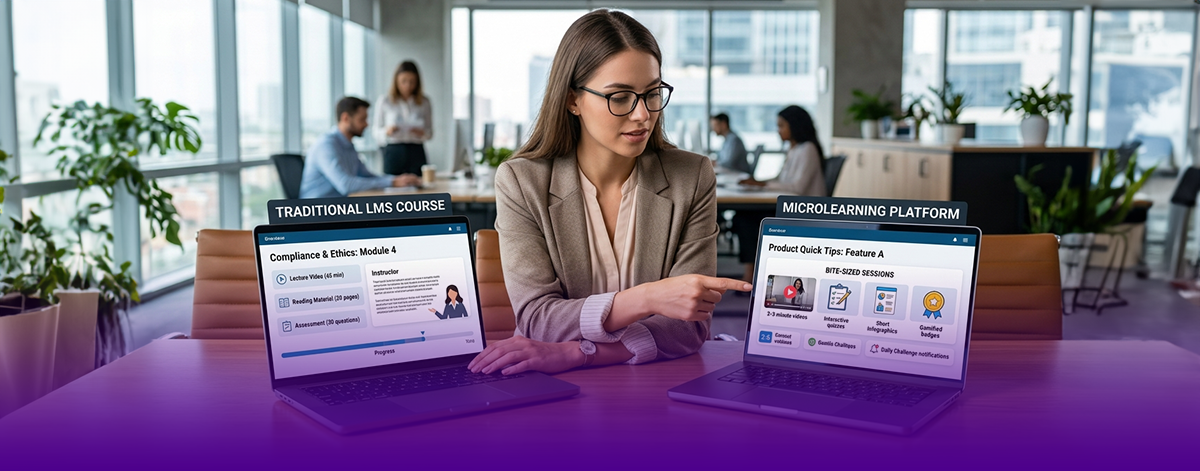
A learning management system keeps this pace by enabling continuous learning. Short refreshers, microlearning content, and real-time updates ensure that agents have constant access to the latest information without stepping away from their work for long training sessions.
Thus, learning becomes part of the workflow, not its disruption.
- Personalized Learning for Diverse Service Teams
No two service agents are at the same stage in their journey. Some need product depth. Others need help with communication or confidence.
That’s why a modern LMS personalizes learning based on role, experience level, performance data, and feedback trends. So, instead of generic training programs, agents receive targeted support that addresses their specific gaps.
This personalized approach improves customer engagement while accelerating performance improvement.
- Linking Training to Customer Experience Outcomes
One of the most valuable aspects of an LMS is visibility. Beyond course completion, organizations therefore can see how learning impacts service performance.
When integrated with service systems, this learning data can be connected to customer outcomes like satisfaction scores, resolution rates, and escalation trends.
These insights allow leaders to move from assumptions to evidence—understanding what training works, where gaps exist, and how learning directly supports business goals.
Strengthening the Human Skills That Define Service Quality
Yet while tools and technology are essential, customer experience is ultimately shaped by human behavior.
Skills like empathy, listening, and problem-solving need continuous reinforcement. And a learning management system supports this human-centricity through short learning moments, reflection-based activities, and ongoing reinforcement rather than one-time workshops.
Over time, this builds service teams that don’t just follow scripts but genuinely understand and respond to customer needs.
- Empowering Managers to Coach
Customer service managers play a crucial role in sustaining this performance. And a modern LMS gives managers visibility into team learning progress and skill gaps, enabling more focused coaching conversations.
Then instead of reacting to issues after they escalate, managers can proactively support their teams with targeted learning and timely guidance that improves both confidence and outcomes.
Scaling Customer Training Without Compromising Quality
As organizations grow, customer service training often becomes more difficult to manage. New regions, new products, and larger teams increase complexity.
A corporate LMS thus ensures training scales smoothly by maintaining consistency while adapting to local or role-specific needs. Growth therefore no longer dilutes service quality—rather, it strengthens it.
From Training Platform to Customer Experience Enabler
Today, a well-designed learning management system is a living ecosystem that supports employees at every stage of their customer service journey.
When learning is continuous, relevant, and closely aligned with real customer interactions, service excellence naturally follows. And when your people are supported in the moments that matter most, customers feel the difference.
So, the question is: Does your LMS merely deliver training, or does it actively enable your customer experience? Leave us your thoughts here.
Other Articles