

August 14, 2026
The Learning Experiences Your Workforce Actually Remembers
July 22, 2026
The $X Billion Skill Gap: What Banks Must Rethink About Workforce Development
May 7, 2026The Learning Experiences Your Workforce Actually Remembers
July 22, 2026The $X Billion Skill Gap: What Banks Must Rethink About Workforce Development
May 7, 2026Competency Mapping vs. Skills Gap Analysis: A 2026 Framework for L&D Teams
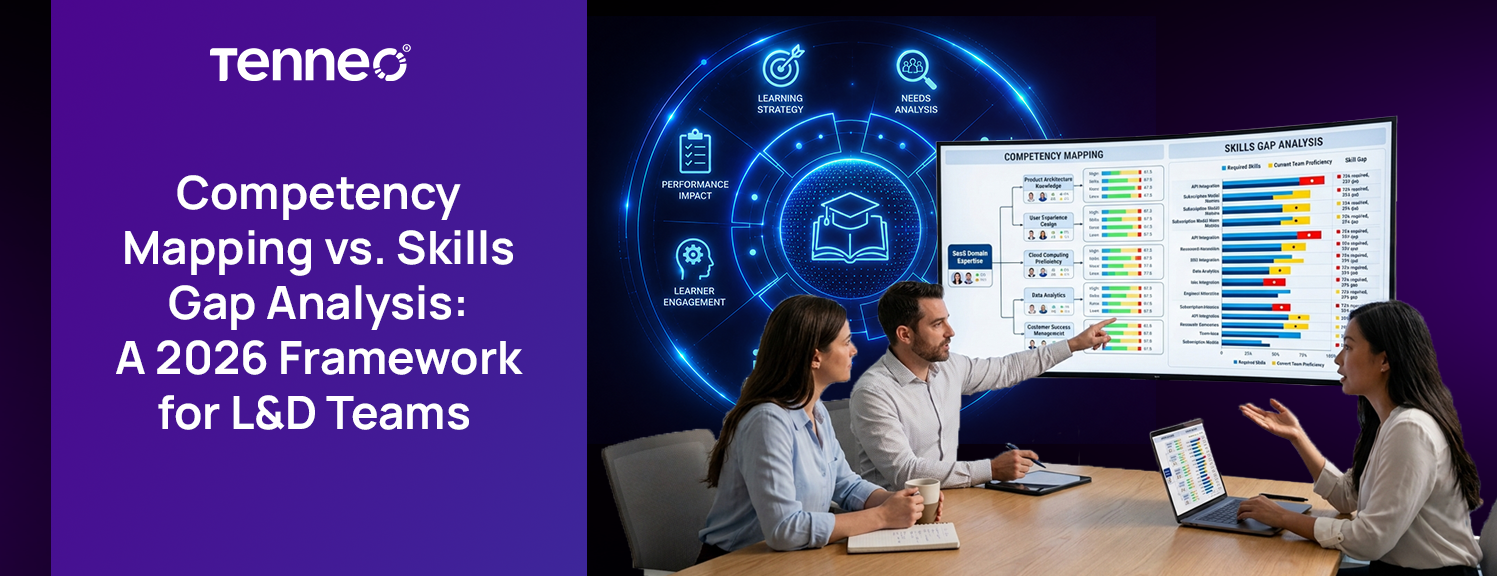
Competency mapping built the reference architecture – the roles, behaviors, and proficiency levels an organization expected at each level. Skills gap analysis then measured today's workforce against that architecture and flagged the shortfall. One was the map; the other was the diagnostic. Run once a year, usually during appraisal season, and filed away until the next cycle.
That model is now visibly cracking. Competency frameworks built for annual refresh cycles can't keep pace with roles that change every few quarters. A 2023 skills taxonomy for a "data analyst" already looks incomplete against what 2026 demands. Static maps decay fast, and gap analyses run against a stale map measure the wrong thing precisely.
Where the world is heading
The shift underway is structural. Three changes define the 2026 posture:
- From periodic to continuous. Competency mapping is becoming a living dataset, updated as roles evolve, not reissued annually. Skills gap analysis is moving from a once-a-year audit to an always-on signal, generated automatically from actual learning and performance data rather than manager surveys.
- From HR-owned to platform-native. The two disciplines are converging inside the Corporate LMS itself, rather than living in separate spreadsheets or a competency module bolted onto performance management. A modern corporate LMS increasingly needs to hold the competency taxonomy, run the gap diagnostics, and recommend the closing intervention, in one loop, not three handoffs.
- From workforce-wide to role-and-individual. Organizations are moving away from blanket training calendars toward hyper-specific interventions: this employee, this role, this exact gap, this course. That precision is only possible when the corporate LMS itself is doing the mapping and the measuring simultaneously, using real completion, assessment, and on-the-job performance data.
What this looks like in practice
A few real-world deployments of Tenneo LMS illustrate how AI-powered competency mapping and skill gap analysis work together in practice.
At Edelweiss, Tenneo's AI-powered competency mapping, assessments, and skill gap analytics improved the accuracy of identifying learning gaps by 85%.
Learning adoption increased by 63%, while compliance-related issues declined significantly. Instead of relying on periodic assessments, competency data became a continuously updated intelligence layer that guided learning decisions.
At Max Life Insurance, Tenneo's learning analytics and performance tracking provided clear visibility into employee progress, training effectiveness, and emerging skill gaps. With competency insights embedded into the LMS, the organization delivered more targeted learning interventions, resulting in a 70% increase in course completion.
At Muthoot Finance, with 6,500+ branches, Tenneo LMS standardized competency-based learning across the enterprise. Every employee followed the same role-aligned learning framework, improving training consistency while increasing compliance efficiency by approximately 75%. Competency expectations were defined, measured, and reinforced through a single platform.
What L&D teams should build toward in 2026
Practically, this means three shifts for any L&D function refreshing its approach this year:
- Retire the static competency spreadsheet in favour of a taxonomy that lives inside the corporate LMS and updates from real usage signals.
- Treat skills gap analysis as a continuous output of the platform, not a periodic project with its own timeline.
- Design interventions at the individual level by default, using the same system that identified the gap to assign, track, and re-measure the fix.
Competency mapping and skills gap analysis were never meant to be sequential exercises. In 2026, the organizations pulling ahead are the ones that have stopped treating them as separate projects altogether and let a single, intelligent corporate LMS run both at once.
Rethinking Your LMS?
If your LMS only delivers courses and tracks completions, it's already behind. Tenneo is an AI-powered advanced LMS platform that combines AI-driven skill intelligence, competency mapping, personalized learning recommendations, performance analytics, and automation to help L&D teams make faster, smarter decisions.
Replace disconnected tools and manual assessments with a single platform that keeps your workforce aligned with changing business needs. Connect with Tenneo or book a demo to experience how AI-powered skills intelligence can help you build a future-ready workforce.