

August 14, 2026
Why Your Employees Remember the Coffee Break Better Than the Training
August 14, 2026
The Learning Experiences Your Workforce Actually Remembers
July 22, 2026Why Your Employees Remember the Coffee Break Better Than the Training
August 14, 2026The Learning Experiences Your Workforce Actually Remembers
July 22, 2026What Makes On-the-Job Training Effective? 5 Methods That Actually Stick
Key takeaways
- Skills gaps, high attrition, and slow internal mobility all point to the same challenge: employees struggle to apply learning where work happens.
- Effective on-the-job training (OJT) combines timely guidance, deliberate practice, continuous feedback, and progressive skill development.
- Traditional LMS platforms measure course completion. High-performing organizations measure workforce capability.
- An AI-powered LMS enables organizations to deliver personalized, contextual learning at scale.
Performance improves when learning happens in the flow of work, reinforced through practice, feedback, and real-world application.
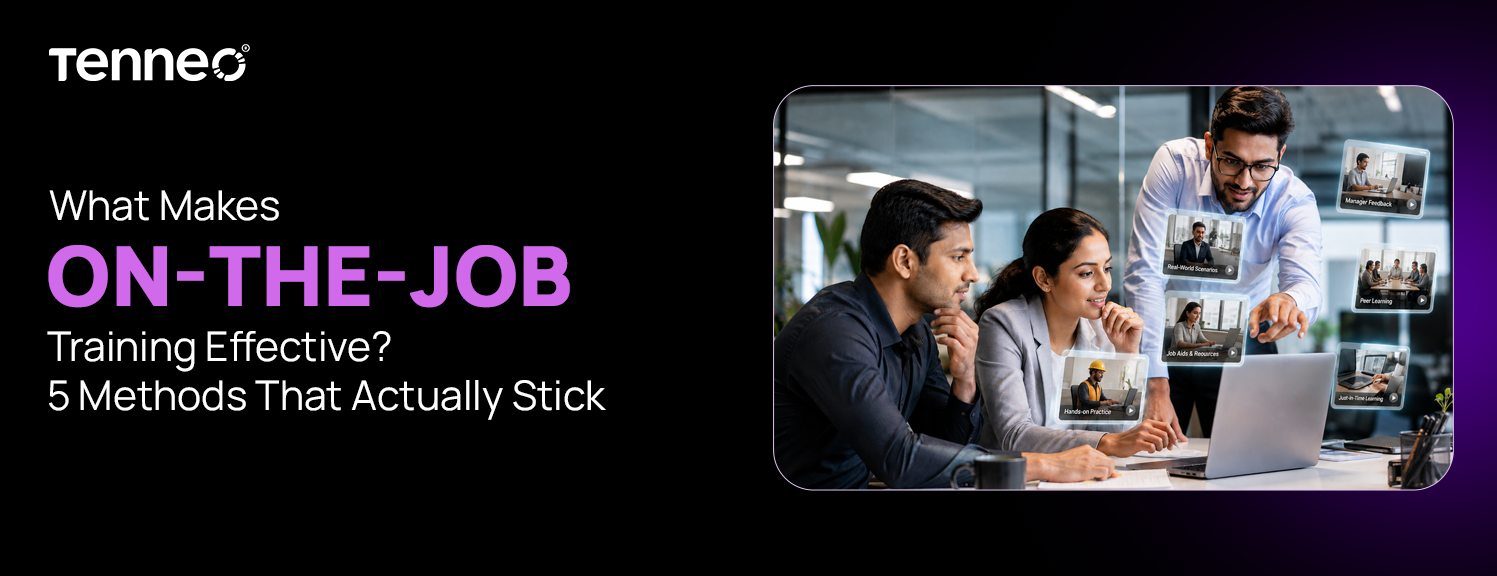
On-the-job training is structured learning delivered while employees perform real work. It combines instruction, practice, feedback, and coaching within the employee's day-to-day responsibilities.
The role of learning is an enabler of workforce capability, helping employees apply knowledge consistently in the moments that matter most.
The question for business leaders has shifted: How do we make learning stick where work happens? And across APAC, that question has become increasingly urgent.
Why APAC organizations feel the pressure
Organizations across APAC are investing heavily in workforce transformation. AI adoption, evolving customer expectations, changing regulations, and new business models are reshaping how work gets done.
Leaders share a common challenge. Employees complete training successfully, while capability gaps continue to affect execution. Recent workforce research highlights the pattern.
|
Workforce Challenge |
What Organizations Are Experiencing |
Learning Challenge |
|
Growing skills gaps |
AI literacy shortages slow transformation initiatives. |
Learning struggles to evolve alongside changing skill requirements. |
|
Rising attrition |
Workforce turnover continues to increase operational costs. |
Learning progress offers limited visibility into workforce readiness. |
|
Limited internal mobility |
Employees struggle to move into emerging roles. |
Skills remain disconnected from career pathways. |
|
Execution pressure |
Business priorities shift rapidly across markets. |
Learning remains separated from day-to-day work. |
|
Manager capability |
Managers need stronger coaching support. |
Limited visibility delays timely intervention. |
Source: Aon 2026 Human Capital Trends Study – APAC Overview, APAC Spotlight: Future @ Work 2026
Individually, these read like five separate HR headaches. They trace back to learning systems that aren't close enough to the work, or smart enough, to compound results.
What effective on-the-job training looks like
On-the-job training places learning inside the work environment, allowing employees to build knowledge while performing real responsibilities.
Learning science consistently shows that people retain information more effectively when they apply it quickly, receive timely feedback, and repeat important behaviours over time.
Five approaches deliver the strongest results across industries.
1. Task-embedded micro-learning
Training that shows up inside the workflow sticks the best. Think about the difference between a two-hour module on handling objections versus a 90-second refresher that appears right before the rep picks up the phone. Same content, very different retention. Context does the heavy lifting.
An AI-powered LMS supports this approach by delivering role-specific learning at the right point in the workflow.
2. Structured peer mentoring
Not casual shadowing, a defined cadence, with clear milestones, feedback checkpoints, and accountability on both sides.
These plays especially well in APAC's relationship-driven work cultures, where trust and social learning already shape how people pick things up. It also happens to be one of the more effective fixes for the internal-mobility problem above; structured mentoring makes career pathways visible, not theoretical.
An effective LMS supports mentoring through shared skills dashboards, competency tracking, and progress visibility for mentors and learners alike.
3. Simulation before stakes
Confidence develops through repetition. Simulations, guided scenarios, and role-based exercises allow employees to experiment, make decisions, and refine their judgement before facing real business situations. This creates stronger decision-making while reducing operational risk.
An LMS with integrated simulations creates one connected learning experience, making practice measurable alongside skill development.
4. Immediate, specific feedback loops
Feedback that arrives a week later has already lost its context. Good OJT closes that loop in hours, not review cycles.
|
Feedback Approach |
Learning Impact |
|
Delayed feedback |
Slower improvement and weaker knowledge retention |
|
Immediate, behaviour-based feedback |
Faster skill development and stronger performance |
Real-time analytics help managers identify coaching opportunities as they emerge, creating continuous improvement across teams.
5. Progressive skill stacking
Each new responsibility builds on an earlier success. Employees move forward after demonstrating competence, creating confidence alongside deeper expertise.
Organizations following progressive learning pathways create smoother onboarding experiences and stronger workforce readiness.
Adaptive learning paths allow an AI-powered LMS to recommend the next skill based on demonstrated capability, creating a personalized learning journey for every employee.
One principle connects every successful OJT programme
Notice the pattern? Every one of these methods is contextual, timely, and reinforced close to the work. And none of them are possible on a static, content-first LMS. Each one leans on the same underlying capability: a system that understands the job, the moment, and the individual.
Making it happen
Tenneo’s AI-powered LMS is built to close the gap by making all five methods above work at scale, surfacing the right micro-content at the right moment, tracking real skill progression instead of course completions, and giving managers the real-time visibility their current systems just can't provide, so you can move faster with confidence.
Learning creates value when it changes how people perform.
On-the-job training creates that change by connecting knowledge with action, one task, one decision, and one experience at a time. Does your learning ecosystem deliver courses, or does it build capability?
Connect with tenneo today to experince the transformative effect.