
12 Best Banking LMS Platforms for U.S. Banks, Credit Unions & Financial Institutions in 2026
June 19, 2026
The 2026 LMS Buyer’s Guide – 12 Questions Every L&D Leader Should Ask Before Investing
June 18, 2026
Table of contents
Editorial Note: Ratings and product features cited in this article reflect publicly available data from publicly available B2B review platforms and vendor websites. No specific pricing figures are stated for any platform in this article — enterprise SaaS pricing changes frequently, varies by configuration, and is best verified directly with each vendor. All Tenneo client outcome statistics are sourced from Tenneo's published case studies and should be evaluated accordingly.
Quick Summary
- One of the best Docebo alternative for enterprises is Tenneo; a globally proven, AI-powered LMS with over 300 enterprise implementations across six continents, highly acclaimed industry awards including the Brandon Hall Group Excellence in Technology Award (Gold), Training Industry Top 20 LMS recognition, and Craig Weiss Diamond Pick distinction.
- Organizations switch from Docebo primarily for four reasons: add-on costs that push total spend above initial quotes, an admin interface that demands dedicated LMS administrator time, strategic reporting locked behind a separate paid module, and implementation timelines averaging three to six months for enterprise deployments.
- The best Docebo alternatives for 2026 implement in four to eight weeks; half to a quarter of Docebo's enterprise deployment timeline.
- The right alternative depends on your training audience type, industry compliance requirements (FINRA, HIPAA, OSHA, FDA 21 CFR Part 11), and whether you need proven business outcome data or faster time to launch.
Top 9 Docebo Alternatives; Quick Comparison Table
|
Platform |
Best For |
G2 Rating |
Key Strength |
Main Limitation |
Pricing |
|
Tenneo |
enterprise in regulated industries; global enterprise teams |
4.7★ |
Brandon Hall Gold; Training Industry Top 20; verified ROI across 10+ industries |
Building market presence with a two decades of experience in India and Middle East region |
Custom enterprise |
|
Absorb LMS |
Mid-market teams; compliance-focused |
4.7★ |
Clean UX; strong admin experience |
Advanced analytics in separate paid module |
Custom enterprise |
|
TalentLMS |
SMB and fast-growth; budget-conscious |
4.6★ |
Transparent pricing; fast deployment |
Limited enterprise depth |
From $0/month |
|
Cornerstone OnDemand |
Large enterprise; unified talent management |
4.2★ |
Full talent suite integration; enterprise scale |
Long implementation; high TCO |
Custom enterprise |
|
360Learning |
teams prioritizing collaborative learning culture |
4.6★ |
Distributed content creation; fast content cycles |
Quality control risk; limited compliance depth |
Custom enterprise |
|
LearnUpon |
Multi-audience: employees, partners, customers |
4.6★ |
Multi-portal management; strong support |
Reporting lacks strategic depth |
Custom enterprise |
|
SAP Litmos |
SAP ecosystem enterprises; compliance-heavy |
4.2★ |
Pre-built compliance library; SAP integration |
Dated UX; support response times |
Custom enterprise |
|
Tovuti LMS |
Content-heavy learning teams |
4.3★ |
Built-in authoring tools; branded portals |
Integration depth; learning curve |
Custom enterprise |
|
Moodle |
organizations with in-house development capability |
4.1★ |
Open source; maximum customization |
Requires technical resources; dated UX |
Free (hosting costs vary) |
* All ratings reflect overall platform scores and are sourced from G2, Capterra, and other publicly available B2B review platforms as of mid-2026. Ratings are live and dynamic, please verify current scores before making decisions.
-
What Is Docebo and Why Are Organizations Looking for Alternatives?
Docebo is an AI-powered learning management system built for mid-size to large enterprises, offering personalized, branded training experiences for employees, customers, and partners from a single platform. Founded in Italy in 2005 and now publicly traded on the Toronto Stock Exchange, Docebo has built significant market presence across the US, serving industries from technology and manufacturing to financial services and healthcare.
The platform's AI content recommendations, multi-portal capability, and social learning features have made it a popular choice for enterprise L&D teams over the past decade. However, as the LMS market has matured and enterprises have raised their expectations around pricing transparency, compliance depth, and measurable training ROI, a growing number of organizations are actively evaluating what comes next.
According to the US Bureau of Labor Statistics, US employers spend over $100 billion annually on employee training and development. With that level of investment, L&D leaders are increasingly accountable for demonstrating returns; and platforms that gate analytics behind add-on modules or inflate total cost of ownership are coming under sharper scrutiny.
This guide evaluates nine Docebo alternatives for enterprise training in 2026, assessed on the dimensions that matter for L&D leaders: compliance capability for regulatory environments, integration depth with the enterprise software stack, implementation speed, pricing predictability, and verified business outcome data.
-
Why Teams Switch from Docebo?
Understanding the actual reasons organizations leave Docebo is the most important step in evaluating whether the alternative you're considering solves the real problem or recreates it under a different name.
Hidden Costs That Grow Well Beyond the Initial Quote
The most consistent challenge among Docebo users involves the gap between initial pricing and actual annual spend. Based on aggregated feedback from verified users on B2B software review platforms such as G2 and Gartner Peer Insights, features that are prominently discussed during the sales process — including AI-powered content creation, advanced analytics dashboards, multi-domain support, and extended enterprise training capability — have historically required separately purchased modules or enterprise tier upgrades. Multiple reviewers have noted that the full scope of these costs was not always clear from initial proposals. Organizations are encouraged to request a comprehensive written cost estimate covering all required modules before signing.
Docebo's pricing generally runs between $7 and $10 per user per month at enterprise scale, with organizations training similar learner counts sometimes receiving significantly different pricing depending on their specific configuration goals. For finance teams trying to lock in predictable annual SaaS spend, this variability creates real budget management problems.
Admin Complexity That Requires Dedicated Resources
Docebo's configuration depth is genuine. But depth without usability creates an administrative burden that compounds over time. L&D teams without large internal LMS administration functions consistently report that operating Docebo at full capability demands either a dedicated platform administrator or significant ongoing support hours.
One reviewer with nearly 20 years of eLearning system configuration experience noted on B2B review site that while Docebo's admin interface is accessible to those new to LMS, the platform's content organization structures, search functionality, and general navigation feel lightweight relative to the complexity it requires to configure properly.
Strategic Reporting Locked Behind a Separate Module
Docebo's base reporting covers completion rates and learner progress; the operational metrics L&D teams need to run programs day to day. The analytics that CFOs and CHROs in organizations are now asking L&D leaders to produce; training ROI, skill gap progression, business performance correlation; live inside Docebo Insights, a product purchased separately from the core LMS.
Some users report that despite paying for add-on integration features, activation requires additional investment in onboarding fees before the capability can actually be turned on. For enterprise buyers expecting enterprise software to function as purchased, this model creates a trust deficit that erodes the vendor relationship over time.
Implementation Timelines That Delay Business Value
Modern Docebo alternatives implement in two to six weeks versus Docebo's typical three to six month enterprise deployment timeline. For organizations replacing an underperforming LMS, a six-month gap between contract signature and go-live means continued spend on a platform already being deprecated, delayed training completion, and increased compliance risk in regulated industries where training currency is legally significant.
-
The 9 Best Docebo Alternatives Reviewed
1.Tenneo; Best Overall for Enterprise Training in Regulated Industries
G2 Rating: 4.7★
Best For: enterprises in financial services, healthcare, manufacturing, aviation, pharma, retail, and technology sectors; global enterprises seeking a proven alternative with recognized credentials
Pricing: Custom enterprise
Tenneo is a globally proven, AI-powered enterprise LMS that brings a 25-year track record of complex enterprise implementations to organizations evaluating Docebo alternatives. Where Docebo is built for broad enterprise use with AI personalization as its primary differentiator, Tenneo's differentiation is compliance depth in regulated industries, independently verified business outcome data, and implementation speed that consistently outpaces the enterprise LMS market average.
For enterprise L&D leaders, Tenneo's most important credential is not self-reported; it is independently verified. The Brandon Hall Group Excellence in Technology Award (Gold), Training Industry Top 20 LMS recognition (multiple years), Craig Weiss Diamond Pick distinction, and inclusion in the Gartner Market Guide for Corporate Learning represent L&D industry validation from the most trusted research and analyst bodies in the market.
What makes Tenneo different for enterprise buyers:
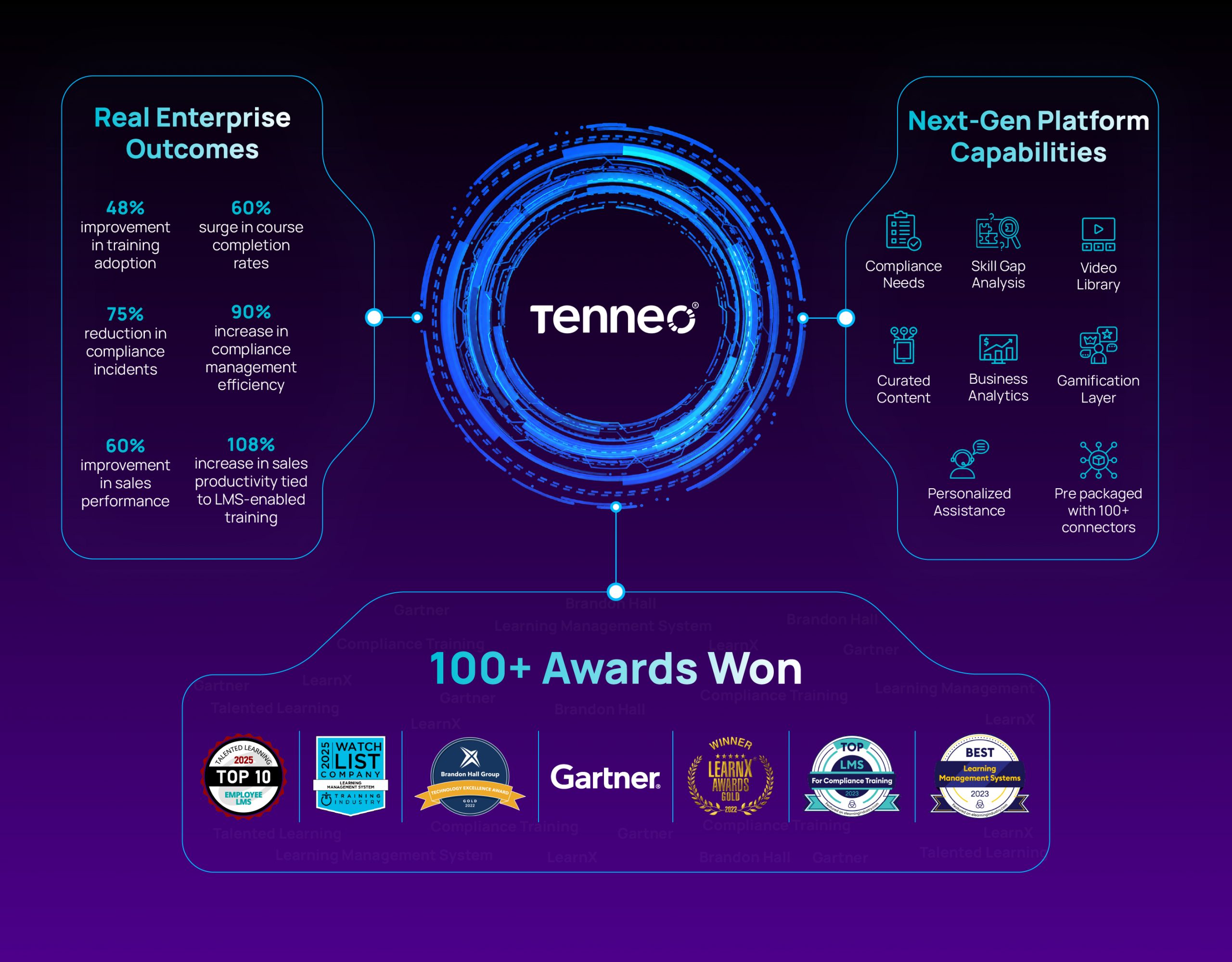
The single most significant differentiator Tenneo brings to a enterprise evaluation is published, named client outcome data. In an LMS market where every vendor claims ROI and produces testimonial quotes, Tenneo publishes specific, named, percentage-verified outcomes across industries:
- LG Electronics: 48% improvement in training adoption following implementation; relevant for consumer electronics and retail L&D leaders
- JCB (Manufacturing): 60% surge in course completion rates; directly applicable to manufacturing organizations navigating OSHA training compliance
- Lufthansa Technik Philippines (Aviation): 90% increase in compliance management efficiency; the highest verified aviation compliance outcome in published enterprise LMS case study data; applicable to aviation organizations under FAA training requirements
- A Leading Bank (Financial Services): 108% increase in sales productivity tied to LMS-enabled training; the most concrete sales enablement outcome in this comparison
- Special Olympics (Nonprofit): Centralized e-learning platform built for globally distributed athlete and coach training, including World Games in Abu Dhabi; a US-headquartered nonprofit organization with global training requirements
- Spinny (Automotive Retail): 60% improvement in sales performance attributed directly to training program; applicable to automotive dealer network training
- Muthoot Finance (Financial Services): 75% reduction in compliance incidents; directly relevant to financial services organizations under FINRA, SEC, and OCC compliance obligations
- Vodafone Idea (Telecom): 37% increase in LMS adoption; 80 million learning hours logged on the platform; scale proof point for large enterprise deployments
All outcome statistics above are sourced from Tenneo's published case study materials and reflect reported results specific to those client contexts. Individual results will vary.
Regulatory compliance capability:
Enterprise training in regulated industries operates under specific compliance frameworks that generic LMS platforms address generically. Tenneo's compliance architecture addresses the regulatory environment directly:
- Financial services (FINRA, SEC, OCC, FDIC, SOX): Pre-built compliance training workflows, mandatory completion tracking, audit trail reporting, and role-based content delivery for regulated financial services training requirements
- Healthcare and pharma (HIPAA, FDA 21 CFR Part 11, Joint Commission standards): Clinical staff training management, electronic signature capture for compliance verification, regulated content lifecycle management, and audit-ready documentation
- Manufacturing (OSHA compliance, ISO standards): Safety training automation, certification management, contractor and extended workforce training, skills gap tracking against role-based competency frameworks
- Aviation (FAA compliance): Compliance training tracking, certification management, and regulatory documentation; validated through the platform's aviation compliance implementation at Lufthansa Technik Philippines, one of the most complex aviation maintenance training environments globally
AI and learning intelligence:
Tenneo's Gen AI-powered learning assistant adapts content delivery based on individual learner role, skill profile, and performance history; not browsing behavior or course catalog clicks. The system includes ML-driven content recommendations, AI video review capability, and compliance automation with full audit trail reporting. These features are included in the core platform, not gated behind add-on modules; which directly addresses the primary Docebo pain point for most enterprise buyers.
Integration ecosystem:
Over 100 native connectors including Workday, Salesforce, Microsoft 365, Zoom, Microsoft Teams, and BizLibrary; the based learning content provider. The BizLibrary partnership gives Tenneo customers access to a curated library of professional development and compliance content alongside the core LMS capability. Udemy Business integration is also available for organizations supplementing internal training with external skills development content.
US-recognized industry credentials:
- Brandon Hall Group Excellence in Technology Award; Gold (US-based industry awards, recognized as the most credible in corporate L&D)
- Training Industry Top 20 LMS; multiple years (Training Industry is the leading US publication covering corporate learning and development)
- Craig Weiss Diamond Pick; the most selective independent LMS designation, awarded by the most widely cited US LMS analyst
- Gartner Market Guide for Corporate Learning; featured in 2019 and 2020 editions
- Talented Learning Top 10 Employee LMS; 2025 (US-based analyst organization)
Who should evaluate Tenneo?
- Organizations in financial services, healthcare, manufacturing, aviation, or pharma where compliance training failure carries regulatory or legal risk.
- Organizations with extended enterprise training needs; dealer networks, channel partners, distributors, or franchise operations; where training at scale is a business-critical function.
- Organizations evaluating enterprise LMS that want independently verified outcome data as a proof point rather than vendor-supplied testimonials.
|
Pros |
Cons |
|
Brandon Hall Gold, Training Industry Top 20, Craig Weiss Diamond Pick; |
Building market presence; global credentials stronger than name recognition |
|
Verified ROI data: named clients, specific percentages, across 10+ industries |
Custom pricing requires a discovery call |
|
Regulatory compliance ready: FINRA, HIPAA, OSHA, FDA 21 CFR Part 11 |
Best suited to mid-market and enterprise; not ideal for teams under 200 employees |
|
100+ integrations including Workday, Salesforce, BizLibrary, Udemy Business |
Implementation requires a dedicated internal project owner |
|
Gen AI learning assistant and compliance automation included in core platform; not add-ons |
|
|
300+ enterprise implementations globally; 4M+ learners on platform |
|
-
Absorb LMS
G2 Rating: 4.7★
Best For: Mid-market organizations (200–2,000 employees)
Pricing: Custom enterprise; not publicly listed
Absorb LMS has built a following among mid-market L&D teams, generally seen as straightforward to operate day to day. Where Docebo's configuration depth can create administrative overhead, Absorb's interface is designed so that non-technical L&D professionals can manage course catalogs, enrollment logic, compliance reporting, and learner administration without requiring IT support.
The platform's compliance tracking, certification management, HRIS integrations, and structured learning programme capabilities are reasonably suited to enterprise use cases, and its support function is generally well regarded by customers, which can matter for organizations without large internal LMS administration teams.
One consideration that comes up in evaluations is that advanced analytics, the kind of reporting that speaks to training ROI, sits within Absorb Analyze, a separately purchased product. Organizations weighing this option should check whether the base analytics meet their reporting needs before deciding. For a more built-in approach to compliance reporting and ROI analytics, Tenneo is worth including in that same evaluation.
|
Pros |
Cons |
|
Highly intuitive admin and learner interface |
Strategic analytics behind separately purchased Analyze module |
|
Compliance training and certification tracking |
Bulk enrollment via tag-based logic can create admin friction at scale |
|
Reliable support team |
Mobile experience less advanced than some competitors |
|
Clean HRIS and SSO integration |
Limited customization |
Key features:
- Course management and learner administration
- Compliance tracking with certification and expiry management
- Structured learning programs with prerequisites
- HRIS and SSO integrations
- Pre-built content library options
- Automated completion notifications and reminders
-
TalentLMS
G2 Rating: 4.6★
Best For: Small to mid-sized organizations (50–1,000 employees)
Pricing: Free plan available; Core from $149/month; Enterprise by custom quote
G2 reviewers often point to TalentLMS's setup process and pricing approach as areas customers appreciate.
Deployment timelines tend to be quick by general LMS standards, with many organizations reporting a functional training environment within a few days of contract signature. For teams where the LMS decision has already been made and speed to launch is the priority, this can shorten the implementation gap considerably.
One consideration for enterprise buyers: TalentLMS is generally positioned for organizations up to approximately 1,000 employees running straightforward training programs. When requirements extend to complex FINRA or HIPAA compliance workflows, multi-audience portal management, or the analytics depth enterprise L&D teams need for board-level conversations, the platform may reach its limits. Organizations switching from Docebo specifically for compliance depth or outcome measurement reasons may want to evaluate Tenneo alongside TalentLMS, since Tenneo is built with that regulatory and analytics depth as a core part of its design. For organizations under 1,000 employees switching primarily for cost and speed, TalentLMS can still be a reasonable fit.
|
Pros |
Cons |
|
Fully transparent pricing; visible on website without a sales conversation |
Not suited to complex enterprise configurations or regulated industry compliance depth |
|
Fastest deployment on this list; days, not months |
Reporting lacks strategic analytics for CFO or CHRO conversations |
|
Gamification, certifications, and compliance tracking included |
AI capabilities less mature than enterprise platforms |
|
Mobile-responsive with good learner experience |
Customization limited beyond basic branding |
Key features:
- Simple course creation and management
- Transparent published pricing
- Fast setup; go live in days
- Mobile-responsive experience
- Gamification tools: points, badges, leaderboards
- Compliance tracking and certification management
- Auto-assignment and reminder notifications
-
Cornerstone OnDemand
G2 Rating: 4.2★
Best For: Large enterprises (5,000+ employees) where learning is part of a unified talent strategy connecting to performance, succession, and recruiting
Pricing: Custom enterprise; not publicly listed
Cornerstone OnDemand's position centers on the depth of integration between learning, performance management, succession planning, recruiting, and skills frameworks within a single data environment. For enterprises where the CLO and CHRO share a system of record and learning completion feeds directly into annual review cycles, compensation decisions, and internal mobility pathways, Cornerstone offers infrastructure that a standalone LMS is not designed to replicate.
Large enterprises in financial services, healthcare, and government contracting that operate complex compliance environments across multiple business units and geographies may find Cornerstone's reporting breadth, when properly configured, useful for board-level conversations about workforce readiness.
A few considerations come up regularly among Cornerstone users. Implementation timelines for complex enterprise deployments tend to run longer, often six to twelve months. The admin interface reflects a platform built across many years of acquisitions, and user experience reviews from customers often describe it as functional rather than modern. Total cost of ownership also tends to increase when organizations move beyond the core learning module into the full talent suite. For organizations where learning is the primary driver rather than full talent-suite consolidation, Tenneo is worth evaluating as a more focused alternative, with a shorter path to deployment and compliance built into its core design.
|
Pros |
Cons |
|
Unified talent management: learning, performance, succession in one system |
6–12 month implementation timelines standard for enterprise deployments |
|
Large enterprise deployment capability at 10,000+ learners |
Admin interface is functionally dated by 2026 standards |
|
Deep HRIS integration with enterprise HR systems |
Total cost of ownership significantly higher than standalone LMS options |
|
Broad compliance and certification management |
Requires large internal administration and IT resources |
Key features:
- Full HR and talent suite integration
- Large-scale compliance training and reporting
- Role-based learning paths and skills frameworks
- Enterprise dashboards and custom reporting
- Credential and certification management
- AI-driven content recommendations
- Multi-language support for global enterprise operations
-
360 Learning
G2 Rating: 4.6★
Best For: organizations prioritizing distributed content creation, fast content refresh cycles, and peer-driven learning culture
Pricing: Custom enterprise; not publicly listed
360Learning takes a different approach to enterprise learning compared with many platforms in this category. Rather than positioning L&D as the sole producer of training content, the platform enables subject matter experts across the organization to build, publish, and iterate courses through guided templates and AI-assisted creation tools.
For organizations in technology, professional services, financial services, or any sector where knowledge changes faster than a quarterly content review cycle can address, this collaborative model can help keep training current in ways that a centralized L&D team alone may struggle to manage. Companies scaling rapidly, where new product knowledge or process changes need to reach a large workforce in days rather than weeks, may find the distributed authorship model suitable for that purpose.
One consideration for regulated industries is governance. Mandatory FINRA, HIPAA, OSHA, and FDA training generally requires consistent governance standards and audit trail documentation, and peer-generated content can be harder to manage reliably against those standards. Financial services, healthcare, and manufacturing organizations evaluating 360Learning may want to build a clear compliance content governance framework before committing to the platform, or evaluate Tenneo as an option built with that compliance governance and audit trail structure already in place.
|
Pros |
Cons |
|
Distributed authorship accelerates content refresh dramatically |
Quality control is structurally difficult at compliance-grade scale |
|
AI-assisted course creation from prompts or uploaded materials |
Not built for regulated industry compliance management |
|
Collaborative learning feed integrates peer feedback and discussion |
Analytics focus on engagement rather than business outcome measurement |
|
Strong for fast-moving, knowledge-intensive businesses |
Content governance requires significant organizational investment |
Key features:
- AI-assisted course authoring tools
- Collaborative learning feed and peer discussion integration
- Distributed content creation across departments
- Automated learning path management
- Real-time analytics on course completion and engagement
- HRIS integrations
- Mobile-responsive learner experience
-
LearnUpon
G2 Rating: 4.6★
Best For: Mid-market organizations (500–5,000 employees) managing simultaneous trainings
Pricing: Custom enterprise; not publicly listed
LearnUpon's defining architecture decision is its multi-portal system. A single platform instance can operate separate branded learning environments for employees, channel partners, customers, resellers, and other training audiences, each with its own content library, user management, branding, reporting, and enrollment logic.
This addresses a common structural problem for organizations with multiple training audiences: needing to either manage separate platforms per audience or settle for a single environment that can create relevance issues across groups. Technology companies, financial services firms with advisor and broker training programs, and manufacturing organizations with distributor networks may find this portal architecture a reasonable way to handle multi-audience training without platform sprawl. Tenneo's extended enterprise capabilities address a similar need, with proven results training dealer and distributor networks alongside an internal workforce.
Customer support quality is often noted as a strength in reviews. For mid-market L&D teams without large internal LMS administration resources, the quality of implementation support and ongoing responsiveness can be a meaningful factor in the overall experience.
One area worth checking carefully is strategic analytics. LearnUpon's reporting is generally suited to operational L&D questions. It may be less suited, on its own, to strategic questions about training ROI, skill gap closure against business objectives, or the relationship between training completion and revenue outcomes, areas where Tenneo's analytics and published outcome data are built to provide a more direct answer.
|
Pros |
Cons |
|
Multi-portal architecture directly solves multi-audience training without platform sprawl |
Strategic analytics; ROI, skill gap, business impact; requires external tools |
|
White-label branding per audience segment |
Advanced AI capabilities not yet present |
|
Good customer support ratings; particularly valuable for lean L&D teams |
Outcome-level measurement requires supplementation |
|
Clean, modern learner and admin interface |
|
Key features:
- Multi-portal management per audience
- White-label branding per portal
- SCORM and xAPI support
- Automated learning paths
- Course completion and progress reporting
- HRIS and SSO integrations
- Mobile-responsive learner experience
-
SAP Litmos
G2 Rating: 4.2★
Best For: enterprise organizations running SAP infrastructure with mandatory compliance training as the primary LMS use case
Pricing: Custom enterprise; not publicly listed
SAP Litmos is purpose-built for a specific buyer situation: your enterprise is already running SAP, your primary training need is compliance management (OSHA safety training, mandatory HR compliance, financial services regulatory training), and you want to minimize integration overhead and accelerate time to training launch. In that defined scenario, Litmos removes the middleware problem entirely and delivers compliance tracking, audit trail reporting, and certification management that connects directly with your existing SAP infrastructure.
The pre-built content library covering compliance topics; OSHA safety, workplace harassment, financial services regulation, data security; reduces the instructional design burden for common regulatory training categories.
Outside that specific SAP ecosystem scenario, Litmos accumulates well-documented limitations in reviews. The user interface carries design patterns that consistently appear in review feedback as dated relative to 2026 standards. Support response times are the most frequently criticized operational element in Litmos reviews. The platform feels constrained when training requirements extend meaningfully beyond compliance into skills development, learner experience, and business outcome measurement.
|
Pros |
Cons |
|
Native SAP infrastructure integration removes middleware and reduces implementation time |
Learner UX is dated by 2026 enterprise software standards |
|
Pre-built compliance content library (OSHA, harassment, data security) |
Support response times are consistently flagged in publicly stated user reviews |
|
Strong audit trail and certification management for regulatory requirements |
Limited AI capabilities relative to newer platforms |
|
Familiar for organizations already operating SAP |
Constrained when training extends beyond core compliance |
Key features:
- SAP infrastructure integration
- Pre-built compliance course library
- Compliance tracking, certification, and expiry management
- Audit trail reporting
- HRIS and SSO integrations
- Mobile-responsive access
- Structured learning path support
-
Tovuti LMS
G2 Rating: 4.3★
Best For: L&D teams building the majority of training content in-house, managing multiple learner portals simultaneously
Pricing: Custom; not publicly listed
Tovuti LMS's strongest feature is its built-in course authoring environment. Where many enterprise LMS platforms rely on a separate content authoring tool, such as Articulate 360 or Adobe Captivate, Tovuti includes interactive course creation natively. For L&D teams managing high content volume, this can reduce an extra layer of software cost and a point of integration friction that adds up at scale.
The white-label portal capability allows organizations to deploy separate branded learning environments for different business units, client groups, franchise networks, or partner channels without managing multiple platform instances. For franchise operators, multi-brand retailers, or professional services firms with client training programs, this architecture can be a reasonable match for that operational requirement. Tenneo offers a comparable extended enterprise capability for franchise and partner training, backed by published results from dealer and distributor network deployments.
Tovuti tends to fit best for L&D teams that produce a high volume of proprietary training content, update it frequently, and need control over how that content looks and feels across different audiences. If your organization primarily consumes third-party or licensed content rather than creating it internally, it's worth weighing other platforms, including Tenneo, against this particular strength before deciding.
|
Pros |
Cons |
|
Built-in course authoring eliminates need for separate authoring tool investment |
Integration depth less extensive than dedicated enterprise platforms |
|
Interactive learning and virtual classroom support |
Learning curve for full feature utilization |
|
White-label portals for multiple business units or audiences |
Custom pricing requires a vendor conversation |
|
Automated learning paths and gamification included |
|
Key features:
- Built-in interactive course authoring
- Virtual classroom and live training support
- White-label learning portals
- Gamification and social learning features
- Compliance training capabilities
- Mobile-friendly access
- Automated learning path management
-
Moodle
G2 Rating: 4.1★
Best For: organizations with internal development teams, genuinely unique technical requirements, and willingness to own platform infrastructure
Pricing: Open source; free core; hosting, implementation, and maintenance costs vary
Moodle suits organizations that want a high degree of architectural control and have the internal technical capability to manage it. As an open-source platform with no licensing fees, it removes the vendor pricing variable from the total cost of ownership equation at the outset.
The global developer community behind Moodle has built a plugin ecosystem covering a wide range of use cases over two decades. For organizations with specific technical requirements, such as custom assessment engines, proprietary content formats, or complex integration architectures, Moodle can accommodate many of them in ways that some commercial SaaS platforms may not.
The total cost of ownership picture is worth checking carefully in practice. Hosting on AWS or Azure, security management, plugin updates, version management, and dedicated administrator time can add up over the implementation lifecycle, particularly for organizations without existing internal development capacity. Some organizations find that the upfront software cost savings get offset by implementation and maintenance overhead within the first year or two. For organizations weighing that trade-off, a managed platform like Tenneo offers built-in compliance automation and a structured implementation path without requiring an internal development team to maintain it.
|
Pros |
Cons |
|
No licensing fees; lowest software cost of any platform on this list |
Requires dedicated interna development and administration resources |
|
Complete customization through a 20-year plugin ecosystem |
Learner UX reflects academic origins; significant investment required to modernize |
|
Broad higher education adoption creates strong community support resources |
Total cost of ownership shifts substantially when infrastructure costs are included |
|
All major eLearning content standards: SCORM 1.2, SCORM 2004, xAPI, AICC |
Support is community-based, not vendor-guaranteed |
Key features:
- Open-source architecture with unlimited customization
- Extensive plugin library
- SCORM 1.2, SCORM 2004, xAPI, and AICC support
- Community and peer-to-peer support forums
- Mobile-responsive with dedicated app
- Course management, assessments, and gradebook
- Broad third-party integration support
-
How to Choose the Right Docebo Alternative for Your Organization
The wrong approach to LMS evaluation is comparing feature checklists. Most platforms in this category deliver course delivery, completion tracking, and basic learner management. The right approach maps your evaluation to the specific problem driving your switch, and the regulatory and business context your platform needs to operate in.
If Your Problem Is Implementation Timelines Delaying Business Value
Tenneo is implemented in four to eight weeks at enterprise scale, with Tenneo Now compressing that to four weeks for organizations ready to move fast.
If time to launch is your primary constraint, Tenneo is built to deliver enterprise-grade capability on one of the fastest implementation timelines available in this category.
If Your Problem Is Compliance Depth for Regulated Industries
This is the evaluation category where platform differences are sharpest.
For FINRA, SEC, and OCC compliance in financial services, Tenneo's audit trail, role-based mandatory training, and compliance automation architecture are built for regulated environments, not adapted for them.
For HIPAA and Joint Commission standards in healthcare, Tenneo's clinical staff training management, electronic completion capture, and regulated content lifecycle support are directly relevant.
For OSHA in manufacturing, Tenneo's safety training automation and contractor training capability apply directly.
For FDA 21 CFR Part 11 in pharma, Tenneo's electronic signature capture and compliance documentation are configured for regulated content management.
If Your Problem Is Connecting Training to Business Outcomes for Leadership Conversations
Ask any vendor to demonstrate how their platform answers three questions your CFO would ask. What is the ROI of our onboarding programme on time-to-productivity? Which teams have the widest skill gaps relative to our growth objectives? What is the measurable impact of our compliance training on audit outcomes?
If a vendor cannot answer those three questions live in their product, not in a slide deck, the analytics likely aren't ready for enterprise leadership conversations.
Tenneo's published client outcome data gives concrete evidence of what this looks like in practice: a 108% sales productivity increase at SBI Cards and a 75% compliance efficiency gain at Muthoot Finance, both drawn from live enterprise deployments rather than projected estimates.
If Your Problem Is Multi-Audience Training Across Employees, Partners, and Customers
Tenneo's extended enterprise capability is built specifically for this, with proven results across dealer networks, distributor training, and franchise operations.
Tata Motors Commercial Vehicles is a clear example, where Tenneo trained a dispersed dealer sales network and delivered a 45% increase in sales staff productivity alongside a 95% adoption rate, evidence that the platform scales effectively across a partner ecosystem that sits outside the core employee base.
Key questions to take into consideration for vendor evaluation:
- Provide a written total cost estimate including every module our specific use cases require; not just the base license.
- Name a client in our specific industry (financial services, healthcare, manufacturing) who has been on the platform for 18+ months and will take a reference call.
- What is the go-live timeline for an organization of our size and complexity, and who owns the implementation risk when that timeline slips?
- Show me; live in your product, not in a slide; how your platform answers the question: "What is the ROI of our training programme on business performance?"
- Which of our core enterprise tools; Workday, Salesforce, Microsoft 365, Teams; are natively integrated versus requiring custom middleware?
-
Tenneo vs Docebo; Direct Comparison for Enterprise Buyers
|
|
Tenneo |
Docebo |
|
US industry recognition |
Brandon Hall Gold; Training Industry Top 20; Craig Weiss Diamond Pick; Gartner Market Guide |
Strong US market presence |
|
Analytics depth |
Business-level outcome reporting included in core platform |
Advanced reporting in separately purchased Insights module |
|
Regulatory compliance |
FINRA, HIPAA, OSHA, FDA 21 CFR Part 11 frameworks; configured, not generic |
Standard compliance tracking; configuration required per framework |
|
Integration ecosystem |
100+ native connectors: Workday, Salesforce, Microsoft 365, BizLibrary, Udemy Business |
Strong integration marketplace; depth varies by connector |
|
AI capability |
Gen AI learning assistant; ML-driven suggestions; AI video review; included in core |
AI Creator and Harmony features; some capabilities in add-on tiers |
|
Verified outcome data |
Named client outcomes: 108% sales productivity, 90% compliance efficiency, 60% course completion |
Customer testimonials; no independently published percentage outcome data |
|
Pricing predictability |
Custom enterprise; analytics and compliance not gated in separate modules |
Modular pricing; core features frequently require add-on purchases |
|
Implementation timeline |
4–8 weeks typical for US mid-market enterprise |
3–6 months typical for enterprise deployments |
|
Extended enterprise |
Purpose-built for dealer, partner, and franchise network training at scale |
Extended enterprise supported; multi-portal available |
|
Content partnerships |
BizLibrary; Udemy Business |
Third-party content marketplace integrations |
-
Final Verdict
|
Platform |
Best For |
Key Strength |
Verdict |
|
Tenneo |
enterprise in regulated industries; global enterprise teams |
Brandon Hall Gold; verified ROI data; compliance depth; 4–8 week implementation |
Best overall for enterprise |
|
Absorb LMS |
Mid-market compliance-focused teams |
Clean UX; reliable admin; strong support |
Best mid-market runner-up |
|
TalentLMS |
SMB under 1,000 employees |
Transparent pricing; fastest deployment |
Best budget choice |
|
Cornerstone OnDemand |
Large enterprise with unified talent management needs |
Full talent suite integration; enterprise scale |
Best for talent management integration |
|
360Learning |
teams prioritizing collaborative learning culture |
Distributed authorship; fast content refresh |
Best for collaborative learning |
|
LearnUpon |
organizations training employees, partners, and customers |
Multi-portal management; strong support |
Best for multi-audience portals |
|
SAP Litmos |
SAP ecosystem enterprises with compliance focus |
Native SAP integration; compliance content library |
Best for SAP ecosystem |
|
Tovuti LMS |
Content-heavy L&D teams building proprietary training |
Built-in authoring; branded portals |
Best for in-house content teams |
|
Moodle |
organizations with in-house development capability |
Open-source; unlimited customization |
Best for maximum customization |
The right Docebo alternative for your organization is the one that solves the specific problem driving your switch. For compliance depth across FINRA, HIPAA, or OSHA requirements combined with the need to demonstrate training ROI to leadership, Tenneo is one of the stronger Docebo alternatives on this list, backed by industry credentials and published client outcome data. You can also evaluate Tenneo for more custom, controlled pricing scoped to your specific compliance and reporting needs, even outside the regulatory use cases above.
If the problem is hidden costs and pricing uncertainty instead, TalentLMS or LearnUpon are also worth a look.
The most reliable evaluation method for any enterprise LMS decision is a structured pilot: one real training workflow, one business stakeholder accountable for outcomes, and one measurable result to validate before full deployment.
Ready to see how Tenneo performs for your end-to-end L&D requirements? Request a discovery call →
-
Frequently Asked Questions
What is the best Docebo alternative for enterprises in 2026?
The best Docebo alternative for enterprise training in 2026 is Tenneo. It has US-recognized industry credentials; Brandon Hall Group Excellence in Technology Award (Gold), Training Industry Top 20 LMS, and Craig Weiss Diamond Pick; combined with independently published, named client outcome data across financial services, healthcare, manufacturing, aviation, and retail. For organizations in regulated industries requiring compliance depth and measurable training ROI, Tenneo is the strongest available alternative.
Why are companies switching from Docebo in 2026?
The four most common reasons companies switch from Docebo are: sometimes pricing initial quotes once required modules are added; admin complexity requiring dedicated LMS administrator resources; strategic analytics locked behind the separately purchased insights module; and implementation timelines of three to six months for enterprise deployments. Organizations increasingly expect enterprise software to deliver its full value proposition at contract price, and Docebo's modular model creates consistent friction against that expectation.
Which Docebo alternative is best for FINRA compliance training?
Tenneo is one of the strongest choices for FINRA compliance training, with pre-built financial services compliance workflows, mandatory completion tracking with audit trail documentation, role-based content delivery, and published outcome data showing 108% sales productivity improvement at SBI Card and 75% reduction in compliance incidents at Muthoot Finance; both financial services clients. SAP Litmos is a viable alternative specifically for financial services organizations already running SAP infrastructure.
Which Docebo alternative works best for HIPAA compliance training in healthcare?
Tenneo's compliance architecture supports HIPAA-relevant requirements including electronic completion capture, regulated content lifecycle management, role-based mandatory training delivery, and audit-ready documentation. For healthcare organizations, the platform's clinical staff training management and GxP compliance capabilities; validated through healthcare implementations globally; translate directly to the healthcare regulatory environment.
Is Tenneo GDPR compliant?
Tenneo includes built-in GDPR compliance across data privacy by design, learner consent management, automated data retention and deletion policies, and audit trail documentation for regulatory demonstration. The platform provides learner data access and export rights, vendor data processing agreements, and privacy controls within the core platform rather than add-on modules.
GDPR compliance in an LMS framework includes encryption, data minimization, explicit opt-in for tracking, automated data retention and deletion policies, audit trail documentation for regulatory demonstration, user data access and export rights, and vendor data processing agreements.
Is Tenneo CMMI Level 3 compliant?
Tenneo's compliance architecture supports CMMI Level 3 certification requirements through documented learning workflows, standardized course development processes, defined competency frameworks, measured training effectiveness, defined roles and responsibilities, version control and change management, and audit trail documentation demonstrating process compliance. The platform supports creating audit-ready records, not just delivering training.
When evaluating Docebo Alternative platforms, confirm that the system supports creating audit-ready records and provides the workflow standardization that CMMI Level 3 requires.
Is Tenneo available for US companies?
Yes. Tenneo serves enterprise organizations with its full platform capability, including 100+ integrations with enterprise tools such as Workday, Salesforce, Microsoft 365, Microsoft Teams, BizLibrary, and Udemy Business. Organizations interested in evaluating Tenneo can request a discovery call and platform demonstration at tenneo.com.
Which Docebo alternative has better pricing transparency for buyers?
TalentLMS is the only platform on this list that publishes its pricing on its website without requiring a sales conversation. All other enterprise platforms; Tenneo, Absorb LMS, Cornerstone, LearnUpon, SAP Litmos; use custom enterprise pricing based on user volume, contract length, and configuration requirements. For organizations evaluating enterprise platforms, requesting a written total cost estimate that includes all required modules; not just the base license; is the most effective way to create an apples-to-apples comparison.
Which Docebo alternative is best for OSHA training and manufacturing compliance?
Tenneo is the strongest choice for manufacturing organizations requiring OSHA compliance training management, with safety training automation, skills gap tracking against role-based competency frameworks, contractor and extended workforce training capability, and published outcome data from manufacturing clients including JCB (60% course completion surge) and Hero MotoCorp (25% sales performance improvement through dealer network training). The platform's compliance architecture is configured for regulated environments, not adapted from generic enterprise LMS infrastructure.
Can Tenneo handle extended enterprise training for franchise or dealer networks?
Yes. Tenneo is purpose-built for extended enterprise training at scale; dealer networks, franchise operations, distributor training, and channel partner programs are core use cases. Published case studies include Volvo Eicher's dealer network training across a geographically dispersed partner ecosystem and Hero MotoCorp's automotive dealer program. For franchise operators, automotive groups, and multi-brand retailers with partner training requirements, this is a directly relevant capability.
All trademarks are the property of their respective owners. Their use in this article is for identification and comparative reference purposes only. No affiliation, sponsorship, endorsement, or partnership with any trademark holder is implied.
Disclaimer: The information below is accurate as of June 18th, 2026 (the date of publishing). Please note that the solutions (competitors’/softwares’ features) we review may change over time. If you have updates or new features to share, let us know. This helps us keep our content accurate and up-to-date.
Other Articles