

What Is Employee Performance, and How Does a Learning Performance Platform Drive It?
August 13, 2026
The Hidden Cost of Disconnected Learning Systems and How Modern LMS Platforms Solve It
June 18, 2026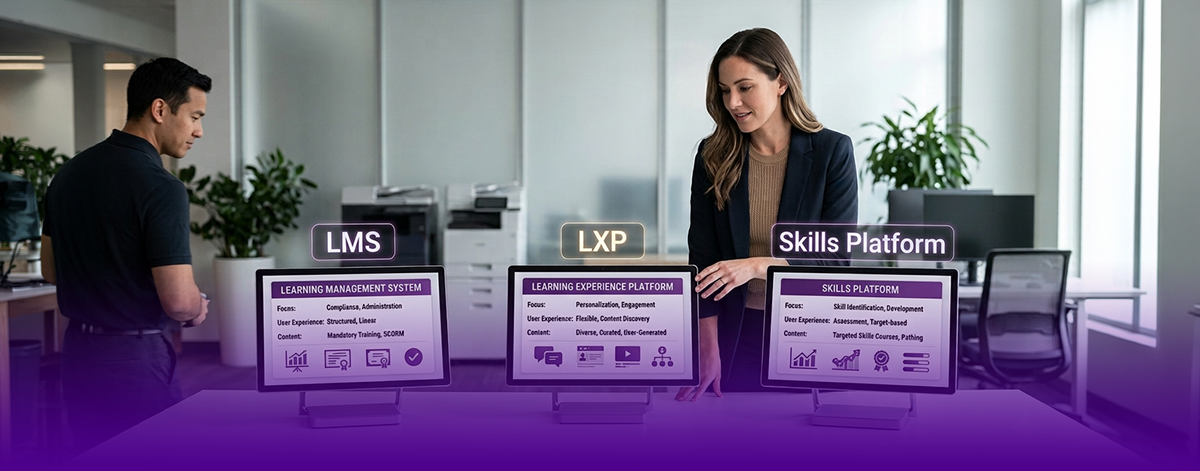
If you've started exploring LMS platforms for your organization, you've probably run into two other acronyms that seem to promise the same thing: LXP and skills platform. Vendors use the terms almost interchangeably in their marketing, which makes the decision harder.
Here's the short version: an LMS delivers and tracks structured training, an LXP personalizes how people discover and consume learning content, and a skills platform measures and maps what your workforce can actually do. Each solves a different problem, and most mature organizations eventually need pieces of all three.
This guide breaks down what separates these systems, where they overlap, and how to figure out which one, or which combination, fits your team's training needs right now.
What Is an LMS (Learning Management System)?
A learning management system is software built to create, assign, deliver, and track training content across an organization. Think of it as the administrative backbone of corporate learning, the system a training manager logs into to build a course, assign it to a department, and pull a completion report before an audit.
LMS platforms are the oldest and most established category in this comparison, and they remain the default choice for training that must happen, on a schedule, with proof that it happened.
Core LMS Capabilities
- Course authoring and content hosting — SCORM/xAPI packages, video, quizzes, and document-based lessons
- Assignment and enrollment rules — automatically enrolling new hires, role changes, or entire departments
- Completion tracking and reporting — dashboards administrators use to prove compliance
- Certification management — renewal reminders for licenses, safety training, and regulatory credentials
- Assessments and grading — quizzes and exams tied to measurable pass/fail outcomes
Where an LMS Shines
An LMS is the right tool when training has a clear, mandatory endpoint: onboarding checklists, workplace safety certifications, HIPAA or GDPR compliance modules, or role-based product training that every new hire must complete in the same order.
LMS platforms provide a more structured and efficient learner experience, and their robust assessment tools make it easier to measure skill development and knowledge retention.
They also tend to integrate smoothly with HR systems and compliance tracking tools, which matters when training records need to hold up in an audit.
Where an LMS Falls Short
The tradeoff is flexibility. Traditional LMS platforms weren't built for self-directed discovery, and they can feel rigid to employees who want to explore a topic outside the assigned curriculum.
A learning management system functions as the command center for L&D teams to create, assign, manage, and track training across the organization, giving administrators visibility into participation and outcomes, but that same top-down structure is precisely what limits informal, curiosity-driven learning.
What Is an LXP (Learning Experience Platform)?
A learning experience platform flips the LMS model around. Instead of administrators pushing assigned courses to employees, an LXP puts the employee in the driver's seat, surfacing content the way a streaming service recommends what to watch next.
An LXP is a learner-centric platform that provides personalized, self-directed learning experiences through AI-powered content recommendations, similar to how a streaming service suggests shows.
Unlike a traditional LMS, an LXP focuses on user-generated content, social learning, and discovery rather than administrator-assigned training paths, aggregating internal courses, external content like articles and industry research, and peer-shared knowledge in one place.
Core LXP Capabilities
- AI-driven content recommendations based on role, past activity, and stated interests
- Content aggregation from internal courses, external providers, articles, videos, and podcasts
- Social and peer learning — comments, ratings, and employee-created content
- Skills tagging on content to connect what someone watches or reads to a broader skill
- Discovery-based search rather than a fixed course catalog
Where an LXP Shines
A learning experience platform is generally designed to layer on top of an LMS, focusing on the user experience and helping employees develop the skills they need for personal and professional growth, rather than replacing structured compliance training outright. If your biggest challenge is engagement- employees ignoring the LMS because it feels like a chore- an LXP is built to solve exactly that.
Where an LXP Falls Short
The same openness that drives engagement can undercut consistency. Because an LXP encourages user-driven content discovery, it can lead to scattered learning experiences that don't always align with corporate learning goals. This is a real risk if your primary need is documented, standardized compliance training rather than exploratory upskilling.
What Is a Skills Platform?
A skills platform is the newest of the three categories, and it starts from a different question entirely. Instead of asking "what course did this person complete?" it asks "what can this person actually do, and where are the gaps across my workforce?"
A skills intelligence platform is software that continuously captures, infers, and activates data about what a workforce can do- not job titles, but verified, up-to-date skills, functioning as a living map of the organization.
These platforms often sit on top of, or integrate with, both an LMS and an LXP, pulling completion data, assessment scores, and manager feedback into a single skills profile per employee.
Core Skills Platform Capabilities
- Skills taxonomies — a standardized, shared language for describing capabilities across roles
- Gap analysis — comparing an employee's current proficiency against what their role requires
- Skills-based talent marketplace — matching employees to internal projects or open roles based on verified skills, not job titles
- Workforce-level analytics — surfacing organization-wide skill gaps for strategic planning
- Continuous tracking — monitoring skill growth (and decay) over time rather than a single snapshot
Where a Skills Platform Shines
Skills-based learning platforms go beyond content delivery, offering structured ways to define, measure, and develop capabilities across an organization, with taxonomies that align training to real business capabilities rather than job titles or tasks alone.
If leadership is asking questions like "do we have enough AI-literate engineers to hit next year's roadmap," a skills platform is built to answer that in a way neither an LMS nor an LXP can on its own.
Where a Skills Platform Falls Short
Skills platforms are typically not built to author or host courses themselves, and their value depends heavily on the quality of the skills data feeding them — self-reported skills, assessment results, and activity from your existing LMS or LXP. A skills platform with no data pipeline behind it is just an empty taxonomy.
LMS vs. LXP vs. Skills Platform: Side-by-Side Comparison
|
Dimension |
LMS |
LXP |
Skills Platform |
|
Primary question answered |
Did they complete the training? |
What should they learn next? |
What can they actually do? |
|
Content model |
Administrator-assigned courses |
Aggregated, AI-recommended content |
Skills data pulled from multiple sources |
|
Best for |
Compliance, onboarding, certifications |
Engagement, self-directed upskilling |
Workforce planning, internal mobility |
|
Reporting focus |
Completion rates, audit trails |
Engagement, content consumption |
Skill gaps, proficiency levels, readiness |
|
Typical buyer |
L&D / compliance teams |
L&D / employee experience teams |
HR/talent strategy/workforce planning |
|
Common limitation |
Rigid, low engagement |
Can drift from business priorities |
Depends on data quality from other systems |
A related category worth knowing is the learning lifecycle platform (LLP), which combines LMS and LXP functionality and may also pull data from talent management systems to factor employee skills and career goals into course recommendations.
It's a sign of where the market is heading: fewer hard lines between these categories, more integrated platforms.
Which One Do You Actually Need?
Most organizations don't pick just one; they pick a primary system and layer the others on as needs grow. A few starting questions can point you in the right direction:
- Do you have mandatory, auditable training? (Safety certifications, regulatory compliance, license renewals) → Start with an LMS.
- Is your biggest problem low engagement with existing training? → Add an LXP on top of your current LMS.
- Does leadership need visibility into workforce-wide skill gaps for hiring, restructuring, or AI readiness? → You need a skills platform, likely integrated with whatever LMS or LXP you already run.
- Are you a small team without dedicated compliance requirements? → A lightweight LMS with basic reporting may be all you need for now.
The traditional distinction between these categories is increasingly blurring as AI and skills-based development reshape workplace learning, so don't be surprised if the vendor you're evaluating for "just an LMS" already has LXP-style recommendations or basic skills tagging built in. Ask specifically what data each module tracks, not just what category label the vendor uses.
Key Takeaway
LMS platforms remain the foundation for structured, auditable training and for many organizations, that's still the highest-priority problem to solve first. LXPs layer personalization and engagement on top of that foundation, while skills platforms translate all that training activity into workforce intelligence leadership can act on.
The right starting point depends on whether your most urgent problem is compliance, engagement, or visibility into what your people can do, and for most growing organizations, the end state is some combination of all three, not a single winner-take-all platform.
Frequently Asked Questions
Other Articles